
85 Views· 09/28/26· Black History
Tuskegee University: Built by Black Hands, Guided by Black Vision

Tuskegee University: Built by Black Hands, Guided by Black Vision
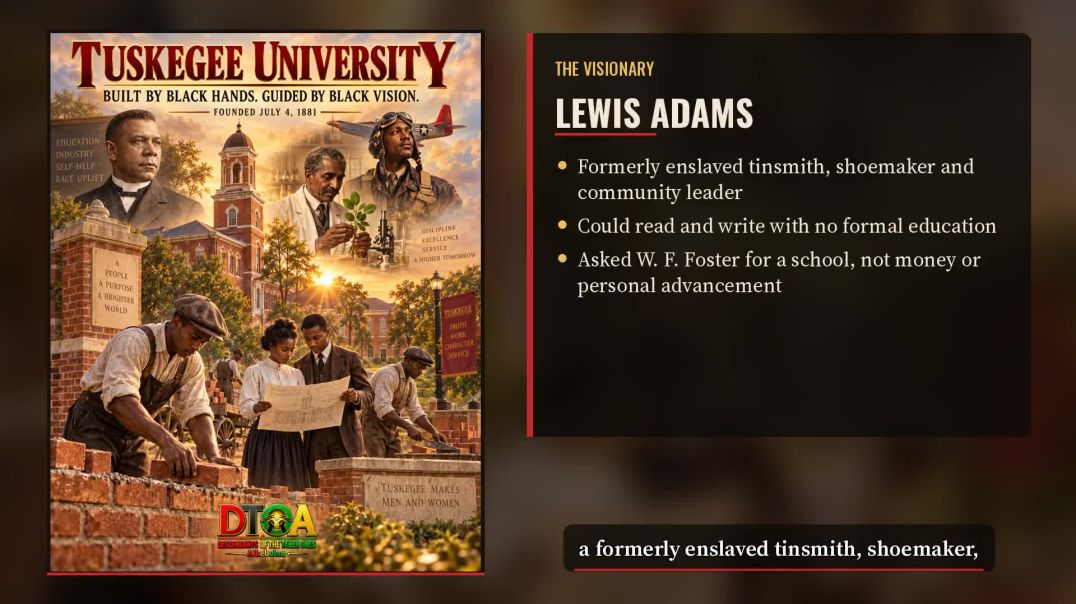
Tuskegee University began with the vision of Lewis Adams, a formerly enslaved tinsmith, shoemaker, and community leader who could read and write despite having no formal education.
When Alabama politician W. F. Foster asked Adams what he wanted in exchange for helping secure the support of Black voters, Adams did not request money or personal advancement.
He requested a school for his people.
That demand helped produce legislation establishing the Tuskegee Normal School for Colored Teachers. The institution opened on July 4, 1881, in a small building provided by Butler Chapel A.M.E. Zion Church. Its first class consisted of approximately 30 students, many of them descendants of people who had been enslaved. (Tuskegee University)
Its founding principal was Booker T. Washington, who arrived to find a school authorized on paper but without a permanent campus, equipment, or adequate funding.
Washington and the surrounding Black community transformed that promise into an institution.
After acquiring an abandoned 100-acre plantation, Tuskegee students learned construction trades, made their own bricks, erected classrooms and dormitories, cultivated the land, and helped build the campus where they were being educated.
They were not simply attending Tuskegee.
They were physically building it.
Washington promoted an education of the “hand, heart, and mind”—combining academics with agriculture, skilled trades, business development, discipline, and service to the community.
In 1896, the brilliant scientist George Washington Carver joined Tuskegee to direct its agricultural program. Carver developed practical methods that helped Southern farmers restore depleted soil, diversify crops, and become less dependent on cotton.
Tuskegee also became associated with other giants, including educator Olivia Davidson, researcher Monroe Nathan Work, architect Robert R. Taylor, and university president Frederick D. Patterson.
During World War II, Tuskegee helped train the aviators, mechanics, instructors, navigators, nurses, and support personnel collectively remembered as the Tuskegee Airmen. Their accomplishments shattered racist claims that Black Americans lacked the ability to master military aviation. (nps.gov)
Tuskegee’s legacy extends far beyond Alabama. It has helped produce generations of scientists, engineers, veterinarians, educators, military leaders, entrepreneurs, and public servants. Its historic campus preserves Booker T. Washington’s home, George Washington Carver’s laboratory, and buildings constructed by the skill and determination of its earliest students. (home.nps.gov)
Tuskegee University represents what happens when Black people transform political power, education, labor, and collective determination into an institution built to outlive them.
.
DTOA—Descendants of the Taken Ones. We preserve the institutions our ancestors built. It began in a borrowed building—but it was never built on borrowed greatness. Tuskegee was conceived by Black vision, constructed by Black hands, and sustained by Black excellence. Thank you for your time. To support the channel. Please like, share, and subscribe, and pass this along to your family and friends. Remember: information kept to yourself is lost over time, but shared information becomes enduring knowledge. People who lose control of their history can be led to believe they never contributed anything.


















2 Comments
cliprize
16 days agoJOSEPH ELISHA
21 days ago