

226 Views· 10/04/26· Black History
When Black Women Sat Down and Made History:

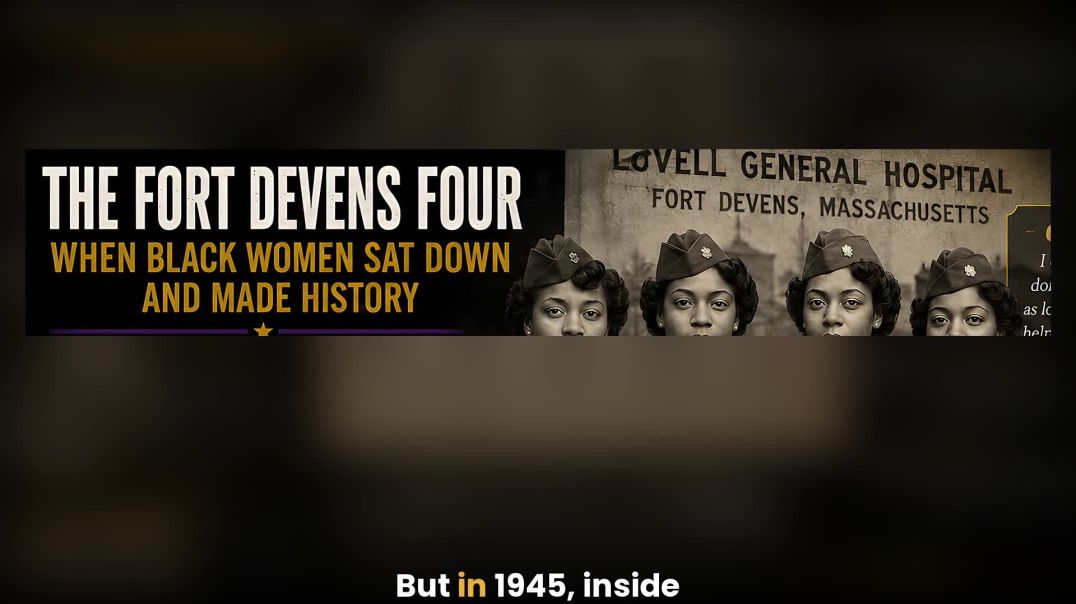
When Black Women Sat Down and Made History: The Fort Devens Four. Four Black women joined the Army seeking opportunity, but when the Army handed them mops instead of the skilled training they had been promised, they sat down and made history. America was fighting a war for freedom overseas, but inside a hospital ward in Massachusetts, four Black women had to fight a different battle while in uniform.
On March 9, 1945, at Fort Devens, Massachusetts, four Black members of the Women’s Army Corps (WAC)—Mary Green, Anna Morrison, Johnnie Murphy, and Alice Young—chose to face a court-martial rather than perform menial cleaning and orderly work that contradicted the skilled technical training they had been promised. Their courageous protest became a landmark World War II resistance movement against systemic military discrimination..
Background and the Protest
• Enlistment expectations: The women joined the WAC expecting to utilize and learn vital technical skills to support the war effort.
• Disparate treatment: Instead, base leadership assigned Black WACs disproportionately to basic janitorial and housekeeping labor at the hospital.
• The strike: After months of ignored complaints, 54 Black WACs initially refused their assignments. While threats of discipline forced most back to work, Green, Morrison, Murphy, and Young stood firm.
Court-Martial and Aftermath
• The trial: In March 1945, the four privates were convicted of disobeying a superior officer and sentenced to a year of imprisonment and hard labor.
• Public outcry: The case triggered intense national scrutiny, drawing sharp criticism from the Black press and civil rights advocates.
• Resolution: Following the widespread public pressure and legal scrutiny, the War Department ultimately dismissed the convictions against the women, spotlighting the deep racial fractures within America's armed forces long before official desegregation.
• The court-martial of the Fort Devens Four, which took place over just two days from March 19 to March 20, 1945, was a highly restrictive military proceeding where racial discrimination was explicitly barred from being used as a valid legal defense. Despite these heavy systemic constraints, the women used their platform to firmly vocalize the military's unequal treatment.
• The Institutional Bias of the Trial
• The Charges: Privates Mary Green, Anna Morrison, Johnnie Murphy, and Alice Young were officially tried under the Articles of War for willful disobedience of a superior officer.
• An All-Higher Rank Panel: The court-martial panel consisted entirely of officers who outranked the defendants—a continuing rule in military courts—and notably included no African American women, consisting instead of two Black men and three white women.
• Silencing Race: The trial judge advocate, Major Leon McCarthy, maintained throughout the prosecution that the racial issue had zero bearing on the legal infraction, reducing a deeply rooted civil rights protest down to basic insubordination.
• The Defense Strategy and Testimony
• The "Orderly" Bait-and-Switch: The defense focused heavily on the fact that white WACs with identical or lesser qualifications were immediately placed into skilled medical technician positions, while the Black women were uniformly reclassified as orderlies to scrub floors and clean latrines.
• The Defendants' Testimony: Defying expectations of compliance, the women took the stand and testified directly about the systemic racial discrimination they experienced at Lovell General Hospital. They made it clear that their refusal was not an aversion to military service, but a direct resistance to segregation.
• The Verdict: Unsurprisingly, under the strict guidelines of military law, the panel found all four women guilty, sentencing them to one year of confinement, hard labor, and a dishonorable discharge.
• The NAACP Intervention and Reversal
• Thurgood Marshall's Involvement: Following the swift conviction, the National Association for the Advancement of Colored People (NAACP), spearheaded by legal giant Thurgood Marshall, stepped in to coordinate a defense campaign.
• Wielding Public Pressure: Rather than fighting solely within the isolated military appellate system, civil rights activists and the Black press mobilized nationwide political outrage. They argued that the treatment of the WACs directly undermined the Allies' supposed fight against fascist oppression abroad.
• The Technical Reversal: Facing immense public pressure and looming congressional inquiries, the War Department caved just a few weeks later on April 3, 1945. They vacated the convictions on an administrative technicality, reinstated the four women to active duty, and quietly transferred the commanding base officer who had instigated the conflict.
• That is why the mop matters.
• It was not just a tool. It was a symbol of a closed door.
• And when those women sat down, they were saying that Black women were not born to stand forever at the edge of someone else’s promise.
• Closing
Anna Morrison, Mary Green, Alice Young, and Johnnie Murphy joined the Army for opportunity, but when the Army handed them mops, they sat down, and history had to stand up.
















4 Comments
Copuffs843
17 days agoLouisKant
19 days agocliprize
20 days agoEstella
20 days ago