
181 Views· 09/18/26· Black History
C. R. Patterson — From Enslavement to an Automotive Empire

C. R. Patterson — From Enslavement to an Automotive Empire
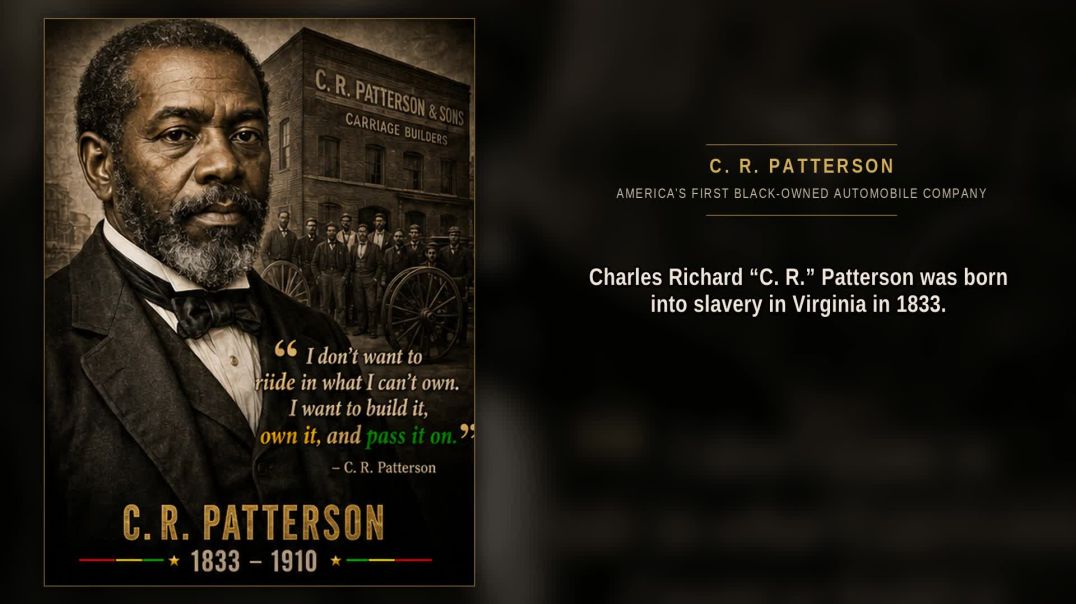
Charles Richard “C. R.” Patterson was born into slavery in Virginia in 1833. The details of how he reached freedom remain uncertain, but by the mid-1800s he was living in Greenfield, Ohio—a community known for its strong abolitionist movement.
Patterson learned blacksmithing and became highly skilled in building and repairing horse-drawn carriages. In 1873, he entered a partnership with white carriage maker James P. Lowe. Twenty years later, Patterson purchased Lowe’s share and reorganized the business as C. R. Patterson, Son & Company.
At a time when most Black Americans faced segregation, racial violence, and exclusion from financing, Patterson built one of the country’s most successful Black-owned manufacturing businesses. His company offered approximately 28 styles of carriages and employed an interracial workforce of roughly 35 to 50 people. Patterson also patented an improved carriage design in 1887. National Inventors Hall of Fame
C. R. Patterson was more than a businessman. When racial discrimination threatened his son Frederick’s education, Patterson challenged the local school system. Frederick subsequently attended Greenfield High School and later broke the color barrier in athletics at Ohio State University.
After C. R. Patterson died in 1910, Frederick Douglass Patterson took control of the family company. Recognizing that automobiles would replace horse-drawn transportation, Frederick led its transition into motor-vehicle manufacturing.
In 1915, the company introduced the Patterson-Greenfield automobile. Available in touring-car and roadster styles, it competed in an industry increasingly dominated by companies such as Ford. Estimates of total production vary, but only a relatively small number were built, and no confirmed surviving Patterson-Greenfield automobile is known today.
The company later shifted to manufacturing bodies for buses, delivery trucks, hearses, and other commercial vehicles. It survived through three generations of the Patterson family before closing in 1939.
C. R. Patterson did not personally build the Patterson-Greenfield automobile—it appeared five years after his death. But he created the skilled workforce, manufacturing operation, family enterprise, and economic foundation that made it possible. Under Frederick’s leadership, C. R. Patterson & Sons became the first—and remains the only widely recognized—Black-owned and operated automobile-manufacturing company in United States history. Smithsonian National Museum of African American History and Culture
C. R. Patterson’s journey from slavery to industrial ownership represents something rarely included in the traditional story of American manufacturing. His family did not merely drive automobiles—they built them.
DTOA honors C. R. Patterson and the Patterson family: Black pioneers who turned iron, skill, education, and generational determination into automotive history. Remembered as the founder of America’s first Black-owned automobile company. Before Detroit ruled the road, a Black family in Ohio built carriages, cars, buses, and history










2 Comments
cliprize
7 days agoJOSEPH ELISHA
21 days ago