

36 Views· 10/25/26· Black History
Charley Willis Before Hollywood made the singing cowboy a familiar figure, Charley Willis was ridin

Charley Willis
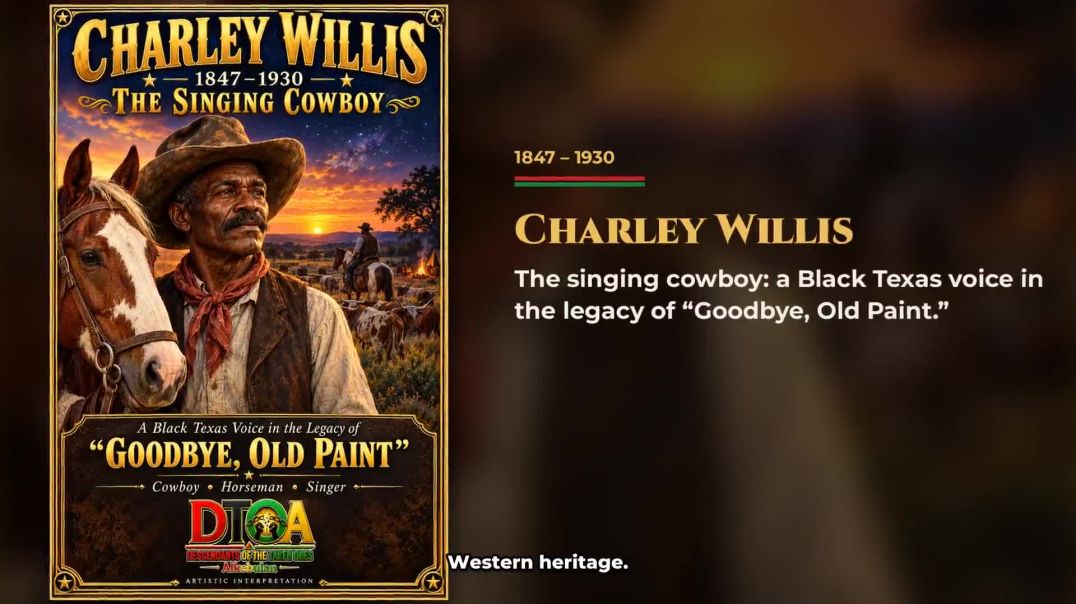
Before Hollywood made the singing cowboy a familiar figure, Charley Willis was riding cattle trails and sharing music that would become part of America’s Western heritage. Born enslaved in Milam County, Texas, in 1847, Willis became a skilled horseman, cowhand, and singer after emancipation. Charley Willis was a Black cowboy, horseman, trail rider, and folk-music figure whose voice helped popularize one of the most famous cowboy songs in American history: “Goodbye, Old Paint.”
Willis was born enslaved in Milam County, Texas, around the mid-1800s. After emancipation, he entered Texas cattle work, where Black cowboys helped drive herds, break horses, guard cattle, sing night songs, and keep the Western economy moving. One account of Texas history says Willis learned the cowboy trade while still enslaved and later worked as a horsebreaker and trailhand. (texasescapes.com)
In 1871, Willis was reportedly hired to help the Snyder brothers of Georgetown, Texas, drive thousands of cattle along the Chisholm Trail toward Wyoming. On long cattle drives, music was more than entertainment. A cowboy’s singing could calm restless cattle at night and help prevent stampedes. Willis became known for that gift — a voice soothing enough to settle herds under the stars. (WUNC)
His name is best known through “Goodbye Old Paint,” a classic cowboy song now credited to Charley Willis. The song was later remembered and adapted by white cowboy fiddler Jess Morris, who said he learned it from Willis. It was collected within the cowboy-song tradition and became one of the best-known songs of the American West. (Wikipedia)
That matters because American cowboy culture is often portrayed as white, even though Black cowboys were central to the real West. They rode trails, broke horses, drove cattle, cooked, scouted, sang, and shaped the sound of the range. Willis’ song proves that Black cowboys not only worked the West — they helped create its music.
A crucial link was Jess Morris, who learned the song from Willis as a boy. Morris later performed it for folklorist John Lomax and continued to acknowledge the Black cowboy who had taught him. Although Willis left no known recording of his performance, that acknowledgment preserved his connection to a song that otherwise might have circulated without his name. WUNC News
That is what makes Willis’s story so significant. Black cowboys contributed their knowledge, labor, and creativity to Western life. Their influence survives in traditions that audiences have not always recognized as partly Black American creations
Charley Willis may not have become famous in his own time the way singers and performers later did, but his voice traveled farther than the trail. It moved through memory, fiddles, and cowboy songbooks, and into American folk tradition. That is what makes Willis’s story so significant. Black cowboys contributed their knowledge, labor, and creativity to Western life. Their influence survives in traditions that audiences have not always recognized as partly Black American creations.
Willis died in 1930, but his musical legacy continued.
Descendants of the Taken Ones. Charley Willis deserves to be remembered as both a working cowboy and a contributor to America’s musical heritage. His voice helped shape the sound of the West, even though no recording of it survives. Charley Willis sang to calm cattle on the trail, but history now hears something larger in his voice — proof that Black cowboys helped write the soundtrack of the American West. Thank you for your time. To support the channel. Please like, share, and subscribe, and pass this along to your family and friends. Remember: information kept to yourself is lost over time, but shared information becomes enduring knowledge. People who lose control of their history can be led to believe they never contributed anything.
#charleywillis #dtoaalkebulan #descendantsofthetakenones #blackcowboys #blackhistory #texashistory #goodbyeoldpaint #westernmusic #CentralTexasHistory












0 Comments