
62 Views· 10/16/26· Black History
Cornelius Robinson Coffey (1903–1994) The Black Aviation Pioneer Who Refused to Let Segregation Kee

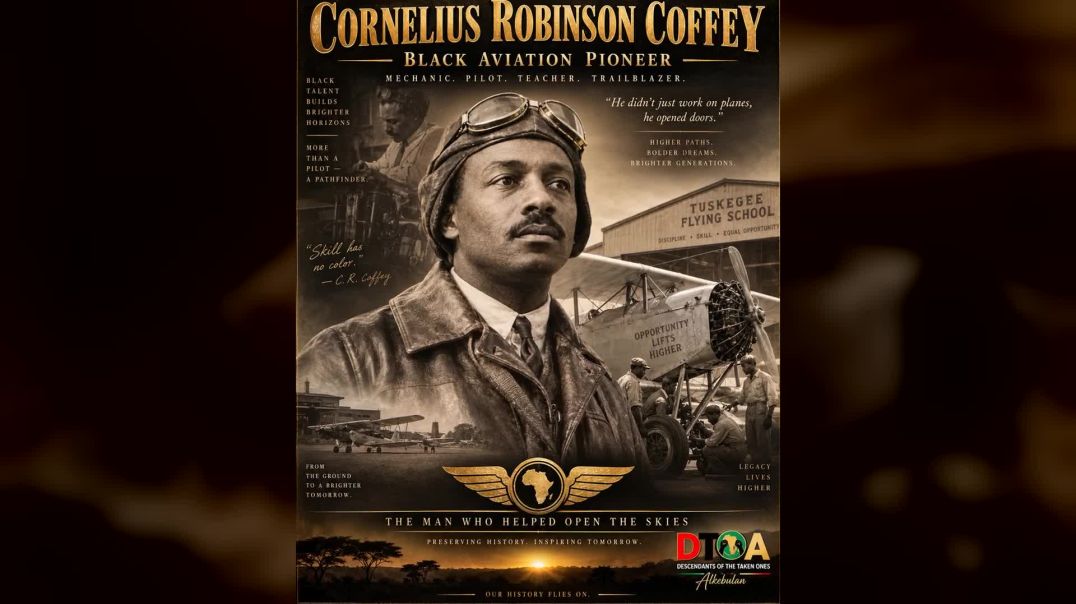
Cornelius Robinson Coffey (1903–1994) The Black Aviation Pioneer Who Refused to Let Segregation Keep His People Out of the Sky
Before the Tuskegee Airmen became legends, a Black mechanic from Arkansas was helping build the schools, aircraft, and training opportunities that made their success possible. His name was Cornelius Robinson Coffey.
Born September 6, 1903, in Newport, Arkansas, Coffey grew up in an America where segregation determined where Black Americans could live, study, work, and travel.
His father worked as a locomotive mechanic, introducing young Cornelius to the world of machinery. An early airplane ride inspired a fascination with flight that would shape the rest of his life.
In 1925, Coffey moved to Chicago to pursue mechanical training and employment. He excelled in automotive engineering, but his ambitions extended beyond automobiles. He wanted to become an aviator.
The aviation industry, however, was largely closed to Black Americans.
Coffey and fellow aviation pioneer John C. Robinson began teaching themselves about airplanes, even building an experimental aircraft powered by a motorcycle engine.
In 1929, both men gained admission to the Curtiss-Wright School of Aviation in Chicago. But when school officials discovered they were Black, they attempted to exclude them. Their employer, Chevrolet dealer Emil Mack, threatened legal action. The school finally admitted both men.
In 1931, Coffey graduated first in his aircraft mechanics class. Robinson graduated second. The institution that initially tried to reject them subsequently invited them back to teach Black students.
National Air and Space Museum
Building opportunities when doors remained closed
Even after becoming a licensed aircraft mechanic and pilot, Coffey encountered racial discrimination at local airfields. Instead of abandoning his ambitions, he joined Robinson and other Black aviators in organizing the Challenger Air Pilots Association. They helped establish an airfield in Robbins, Illinois, one of the earliest Black-operated aviation facilities in the United States. After a destructive storm damaged the field, Coffey and his colleagues found a new opportunity at Harlem Airport near Chicago.
There, Coffey established the Coffey School of Aeronautics in 1938, working closely with pioneering aviator Willa Brown. Brown became the first Black woman to earn a U.S. commercial pilot's license. She and Coffey were also married for a period. Their school welcomed Black students who had been excluded elsewhere, and it trained women as well as men.
Between 1938 and 1945, more than 1,000 students passed through the Coffey School of Aeronautics. Many later became part of the Tuskegee Airmen program during World War II.
National Air and Space Museum
His contributions to World War II
Coffey's school became part of the federal Civilian Pilot Training Program, helping prepare Black aviators at a time when the U.S. military still enforced racial segregation. The institution offered flight instruction, aviation mechanics, and advanced aviation training.
By 1941, its fleet had expanded to ten aircraft. When the government refused to fund housing for some students, community supporters helped construct a dormitory. Coffey and Brown also contributed personal earnings to assist students who lacked financial resources. In 1942, Coffey received a commission as a captain in the Civil Air Patrol.
His work helped establish a pipeline of qualified Black aviators before and during the war, demonstrating that racial exclusion was a barrier imposed by institutions—not a reflection of ability.
National Air and Space Museum
An educator, inventor, and civil rights pioneer
Coffey's achievements extended beyond pilot instruction.
He became recognized as the first Black American to hold both pilot and aircraft mechanic licenses, and he developed an aircraft carburetor-heating invention.
After World War II, he taught aviation mechanics at educational institutions, including Chicago's Dunbar Vocational High School. His instruction helped prepare some of the first Black mechanics hired by commercial airlines. He retired from formal teaching in 1969 but remained active in aviation as an aircraft inspector and mechanic examiner.
Smithsonian Institution
Honors and lasting legacy
Coffey's lifetime of achievements eventually received national recognition.
• 1980: The FAA established the COFEY navigation intersection near Chicago Midway Airport in his honor.
• 1991: The National Aeronautic Association recognized him as an Elder Statesman of Aviation.
• 1993: The Cornelius R. Coffey Aviation Education Foundation was established to support aspiring aviation maintenance professionals, particularly women and minorities.
• March 2, 1994: Coffey died at age 90.
• 2023: He was inducted into the National Aviation Hall of Fame.
National Air and Space Museum
He did not wait for permission
Cornelius Robinson Coffey's story illustrates an important part of African American history.
He did not merely overcome exclusion. He helped build an alternative educational infrastructure that gave other Black Americans access to aviation.
When schools rejected him, he fought for admission.
When airports excluded him, he helped establish an airfield.
When Black students lacked aviation opportunities, he trained them.
And when military segregation continued to restrict Black Americans, he helped prepare the aviators whose service would challenge the prevailing assumptions of their era.
Cornelius Robinson Coffey did more than learn how to fly. He helped make it possible for generations of Black Americans to follow him into the sky.
The Coffey School of Aeronautics
In 1938, Coffey founded the Coffey School of Aeronautics, the first Black-owned and operated flight school in the United States. Together with his wife, pioneering aviator Willa Brown, he trained hundreds of aspiring pilots. (Wikipedia)
The school:
• Trained more than 1,000 aviation students.
• Produced approximately 200 future Tuskegee Airmen.
• Became one of the most important pipelines for Black military aviators during World War II. (Wikipedia)
Descendants of the Taken Ones remember "Cornelius Coffey did more than teach people to fly—he gave an entire generation permission to dream beyond the limits society placed upon them. Every Black pilot who took to the skies after him flew along a path he helped create." Thank you for your time. To support the channel. Please like, share, and subscribe, and pass this along to your family and friends. Remember: information kept to yourself is lost over time, but shared information becomes enduring knowledge. People who lose control of their history can be led to believe they never contributed anything.
#

















1 Comments
Copuffs843
2 hours ago