
318 Views· 09/05/26· Black History
The Black Woman Whose Code Helped Launch America Into Space Annie Easley

The Black Woman Whose Code Helped Launch America Into Space Annie Easley
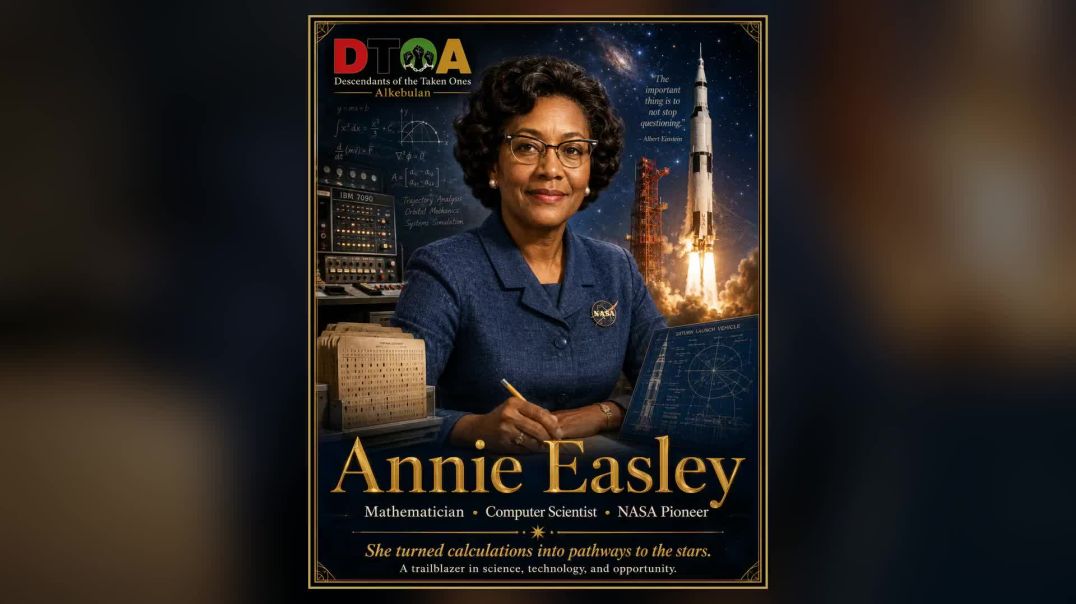
Before modern computers could perform millions of calculations in seconds, NASA relied upon gifted mathematicians known as “human computers.” One of those pioneers was Annie Jean Easley—a Black mathematician, computer programmer and scientist whose work supported spaceflight, renewable energy research and early hybrid-vehicle technology. Born on April 23, 1933, in Birmingham, Alabama, Annie grew up under racial segregation. Her mother repeatedly reminded her: “You can be anything you want to be, but you have to work at it.” Annie took those words seriously. She graduated as valedictorian of her high school class and attended Xavier University of Louisiana, where she studied pharmacy. After moving to Cleveland, Ohio, she read a newspaper story about twin sisters working as human computers at the National Advisory Committee for Aeronautics, or NACA.
Annie applied immediately. In 1955, she was hired by NACA’s Lewis Flight Propulsion Laboratory—three years before the agency became part of NASA. She was reportedly one of only four Black employees among approximately 2,500 people working at the laboratory. Her earliest assignments required her to solve complex mathematical problems by hand. She performed calculations and helped run simulations for the planned Plum Brook nuclear-reactor facility.
But technology was changing. Electronic computers began replacing human calculation teams, and Annie refused to be left behind. She taught herself computer programming and became skilled in languages including FORTRAN and SOAP. She transformed mathematical equations into code that powerful machines could process. Her programs analyzed energy-conversion systems, alternative power sources and battery-storage technology. This research contributed to developments later associated with early hybrid and electric vehicles. Annie also worked on software supporting the Centaur upper-stage rocket—a high-energy launch system that became essential to American space exploration. Centaur helped send communications satellites into orbit and enabled missions to explore the Moon and distant planets. NASA credits Easley’s contributions with helping establish the technological foundation for later missions, including the 1997 launch of Cassini toward Saturn.
While working full time, Annie returned to college and earned a bachelor’s degree in mathematics from Cleveland State University in 1977. NASA had previously provided financial assistance for many employees seeking additional education, but Easley discovered that she had been denied that support. She continued anyway. That was how Annie Easley confronted discrimination. She acknowledged that racism and sexism existed, but she would not allow either to decide her future:
“If I can’t work with you, I will work around you.” Her determination was not limited to her own advancement. Easley became an Equal Employment Opportunity counselor at NASA, helping employees address discrimination involving race, gender and age. She also challenged workplace expectations for women, including rules and customs that discouraged them from wearing pants. Through NASA’s Speakers Bureau and educational programs, she encouraged young people—especially Black students and girls—to pursue mathematics, science and technology. She wanted them to see that they belonged in laboratories, engineering facilities and space programs.
Easley retired in 1989 after 34 years of federal service. She died on June 25, 2011, leaving behind a legacy written not only in history books but also in the computer code and technological systems that helped move America into the space age. Annie Easley was not an astronaut. She never received the public attention given to the people who traveled aboard the spacecraft. But before rockets could rise, someone had to calculate, program, and test the systems that made their journeys possible. Annie Easley was one of those extraordinary minds working behind the mission—turning mathematics into code and code into exploration. She entered a workplace where very few people looked like her. She remained long enough to help transform both the technology and the institution itself. Annie Easley did not simply find a place at NASA. She helped program the future.
Inclosing
Annie Easley turned numbers into pathways beyond Earth. In an era when Black women were often pushed out of scientific spaces, she entered the space program with discipline, brilliance, and quiet power. She began as a human computer, calculating by hand, then rose with the machine age to become a computer programmer whose work helped propel rockets higher. Her legacy is not only in spaceflight—it is in every young mind that learns that intelligence, persistence, and courage can break barriers as surely as rockets break the sky.
To support the channel, please click the like button and subscribe to receive new videos
















2 Comments
cliprize
12 days agoCopuffs843
1 month ago