

313 Views· 09/12/26· Black History
VIOLA DESMOND — THE WOMAN WHO REFUSED TO MOVE

VIOLA DESMOND — THE WOMAN WHO REFUSED TO MOVE
DTOA — Descendants of the Taken Ones
Nine years before Rosa Parks refused to give up her bus seat in Montgomery, Alabama, Viola Desmond refused to leave her seat at a theater in Nova Scotia, Canada. Her story reveals a history too often overlooked: racial segregation also existed north of the United States border.
Born July 6, 1914, in Halifax, Desmond became a successful Black businesswoman. She established a beauty salon, developed beauty products, and opened a school that trained Black women for careers and for starting their own businesses. When discrimination restricted opportunity, she helped create it. The Canadian Encyclopedia
Then a broken-down car put her in the path of a confrontation that would become part of Canadian civil rights history.
On November 8, 1946, while traveling for business, Desmond stopped in New Glasgow for car repairs. To pass the time, she visited the Roseland Theatre.
She took a seat on the main floor, where she could see the screen more clearly. But the theater reserved that section for white patrons and directed Black customers to the balcony. When Desmond tried to buy a main-floor ticket, staff refused to sell her one.
She returned to her seat and refused to leave.
She was forcibly removed, arrested, and held overnight. The authorities prosecuted her over the one-cent difference in amusement tax between a balcony ticket and a main-floor ticket—even though the theater had refused her attempt to pay for the correct seat. She was fined $20 plus $6 in court costs. Canadian Museum of History
A tax charge gave racial discrimination the appearance of ordinary law enforcement.
With support from members of Nova Scotia’s Black community, Desmond challenged her conviction. Although her legal efforts failed, her resistance helped mobilize opposition to segregation.
She belonged to a longer tradition of Black Canadian resistance. In 1941, Carrie Best and her son had challenged segregation at the same theater. Remembering them together reveals a community’s ongoing struggle for dignity. Canadian Museum for Human Rights
Desmond died on February 7, 1965, at age 50, without seeing her name officially cleared. Her younger sister, Wanda Robson, later helped bring her story to a wider public.
In 2010, Nova Scotia granted Desmond a posthumous free pardon, recognizing that her conviction was a miscarriage of justice, and issued an apology. Bank of Canada
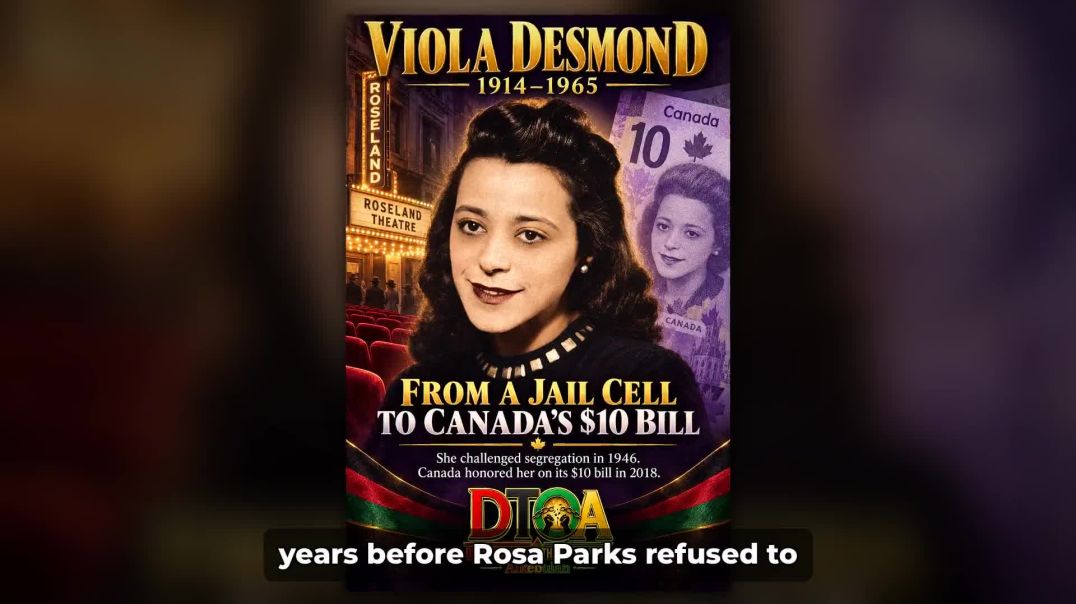
In 2018, her portrait appeared on Canada’s new $10 banknote—the first regularly circulating Canadian banknote to feature a Canadian woman. Canadian Museum for Human Rights The country whose justice system once punished her now carries her portrait in its currency. Viola Desmond was an entrepreneur, an educator, and a woman who defended her dignity when doing so carried a price. Her legacy asks us to remember both the courage of those who resist injustice and the communities that help carry their struggle forward.
We are DTOA—Descendants of the Taken Ones. We recover overlooked stories and honor the people who made them. VIOLA DESMOND FROM A JAIL CELL TO CANADA’S $10 BILL.” Thank you for your time. To support the channel. Please like, share, and subscribe, and pass this along to your family and friends. Remember: information kept to yourself is lost over time, but shared information becomes enduring knowledge.
















1 Comments
cliprize
21 days ago