

150 Views· 09/25/26· Black History
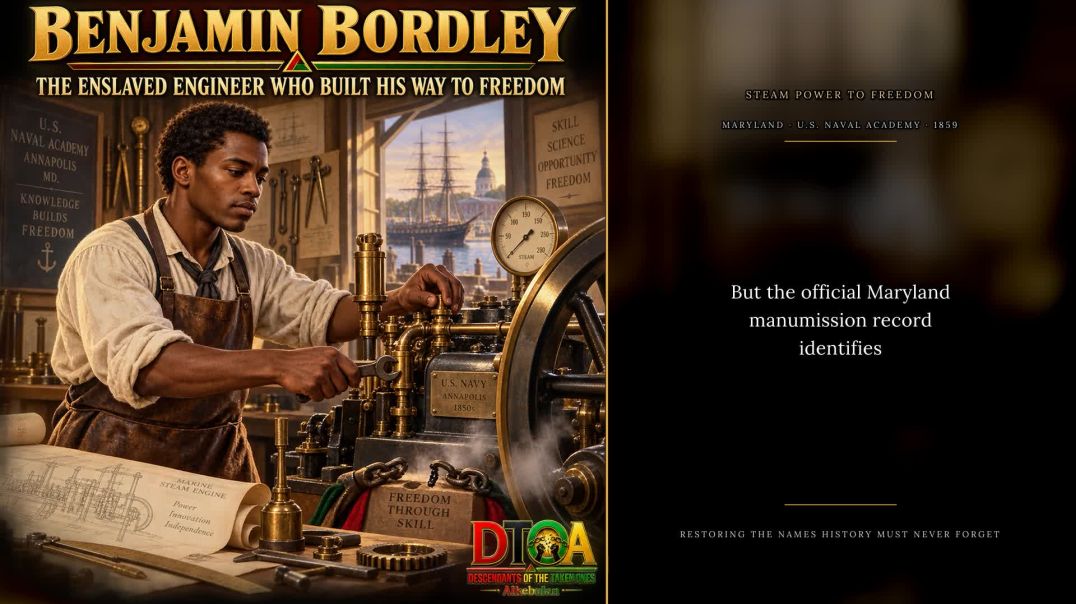
Benjamin Bordley: The Enslaved Engineer Who Built His Way to Freedom

Benjamin Bordley: The Enslaved Engineer Who Built His Way to Freedom
History often remembers him as Benjamin Bradley.
But the official Maryland manumission record identifies him as Benjamin Bordley.
Born enslaved in Maryland around 1830, Bordley displayed extraordinary mechanical skill from an early age. Historical accounts report that, while still a teenager, he built a small, working steam engine from materials that included a gun barrel, pewter, and pieces of steel.
His talent was impossible to ignore.
Bordley was eventually appointed as an assistant in the Department of Natural and Experimental Philosophy at the United States Naval Academy in Annapolis. There, he prepared scientific demonstrations, worked with laboratory equipment, and deepened his knowledge of arithmetic, algebra, geometry, and mechanical engineering.
Although he worked inside one of America’s leading educational institutions, he remained enslaved.
Most of the money he earned went to the man who claimed ownership over him. Bordley was reportedly permitted to retain only a small amount each month.
Still, he continued designing.
Historical accounts credit Bordley with building an improved marine steam engine powerful enough to propel a small naval vessel. Yet because he was legally classified as property, he could not secure a patent in his own name or receive the full recognition afforded to a free white inventor.
America could use his intelligence while denying him ownership of his own life.
Bordley nevertheless found a way to turn his mechanical brilliance into freedom. Money connected to his engineering work, along with assistance from supporters at the Naval Academy, helped raise the price demanded for his release.
On September 30, 1859, John T. Hammond signed the document freeing him in exchange for $1,000—a tremendous sum at the time.
The official record describes him as:
“My negro slave Benjamin Bordley.”
Those words reveal the cruelty of the system—but they also preserve the name that history later distorted. After gaining his freedom, Bordley reportedly continued working with machinery and building steam engines. His story represents more than a single invention. It reveals how much Black scientific and mechanical knowledge existed within American institutions even as Black inventors were denied patents, ownership, credit, and opportunity.
Benjamin Bordley was not merely an enslaved assistant who happened to work around educated men.
He was an engineer.
He studied how machines operated.
He designed engines.
He contributed to naval technology.
And he used his knowledge to help purchase the freedom that should never have been taken from him.
The injustice was not that enslaved Africans lacked intelligence.
The injustice was that America benefited from their intelligence while legally denying their humanity.
Later publications may have called him Benjamin Bradley, but Maryland’s own freedom record tells us the name written when his bondage ended:
Benjamin Bordley.
We are the Descendants of the Taken Ones, and part of our responsibility is restoring the names, achievements, and humanity that history attempted to erase.
Say his name correctly. Benjamin Bordley, the enslaved engineer who built his way to freedom. Thank you for your time. To support the channel. Please like, share, and subscribe, and pass this along to your family and friends. Remember: information kept to yourself is lost over time, but shared information becomes enduring knowledge. People who lose control of their history can be led to believe they never contributed anything.






2 Comments
cliprize
13 days agoJOSEPH ELISHA
20 days ago