
304 Views· 09/27/26· Black History
DR. JAMES EDWARD SHEPARD THE MAN WHO BUILT A UNIVERSITY

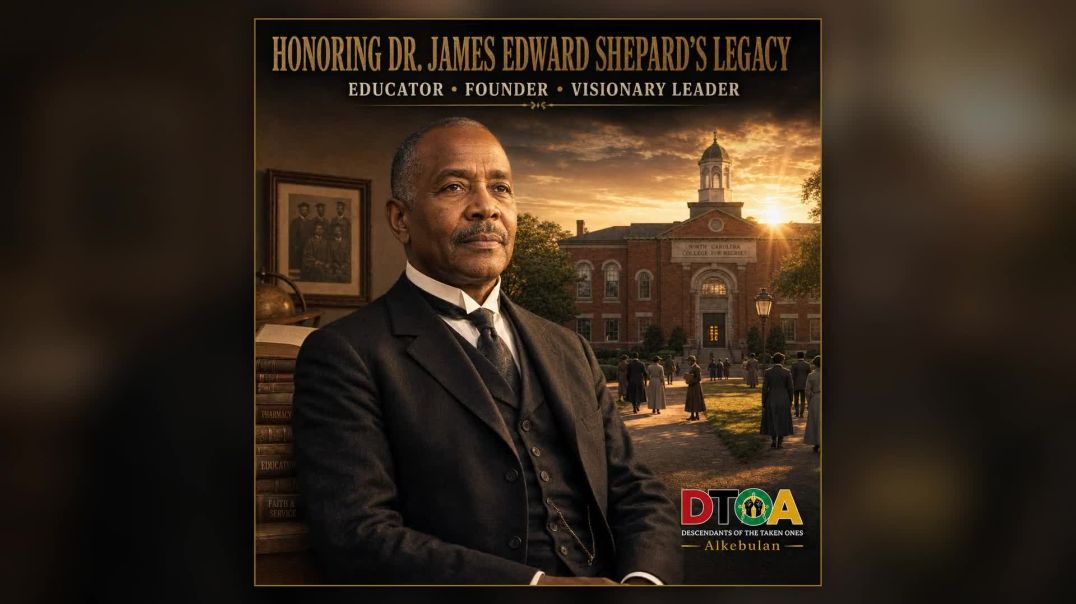
DR. JAMES EDWARD SHEPARD
THE MAN WHO BUILT A UNIVERSITY
There are men who enter history because they were given power.
And then there are men who enter history because they built power where almost none existed.
Dr. James Edward Shepard was one of those men. Born on November 3, 1875, in Raleigh, North Carolina, Shepard entered the world only a decade after the Civil War. Slavery had ended, but Black Americans were still fighting for education, political rights, economic opportunity, and basic equality. Shepard grew up understanding that freedom without knowledge could remain fragile. Education became his weapon. He attended Shaw University, one of the oldest historically Black universities in America, and graduated in 1894 with a degree in pharmacy. His life would become much larger than pharmacy.
He entered the growing Black business community of Durham, North Carolina, a city that would eventually become famous for its powerful African American commercial district, often remembered as Black Wall Street. He became involved with the institution that would develop into the North Carolina Mutual Life Insurance Company, one of the most successful Black-owned businesses in American history. He was also connected to the development of Mechanics and Farmers Bank.
These institutions represented something important.
During Jim Crow, Black Americans were routinely denied equal access to banks, businesses, universities, insurance companies, and government opportunities.
On July 5, 1910, Shepard opened the National Religious Training School and Chautauqua for the Colored Race in Durham.
That institution would eventually become North Carolina Central University.
He raised money. He built political relationships. He found supporters. And he kept pushing. The institution changed names several times as it grew. It became the National Training School, then the Durham State Normal School after receiving state support.
In 1925, it became the North Carolina College for Negroes, developing into a four-year liberal arts college. It became the first state-supported liberal arts college established for African Americans in the United States. That achievement was extraordinary.
A Black man born only twelve years after the Emancipation Proclamation had helped create a state-supported institution where descendants of enslaved Americans could pursue higher education. Shepard understood something powerful:
Political freedom means little if a people have no institutions capable of developing their own future.
His leadership style reflected the difficult world in which he lived. Shepard worked inside a political system dominated by white officials while trying to increase educational opportunities for Black citizens. His methods were often strategic and diplomatic rather than openly confrontational. His battlefield was the institution.
Shepard remained president of the institution he founded for nearly four decades. He watched a small training school develop into an increasingly powerful college. On October 6, 1947, Dr. James Edward Shepard died in Durham, North Carolina. But his institution survived him. That may be the greatest measure of his success.
An institution can educate generations. The school later became North Carolina College at Durham. In 1969, it adopted the name millions recognize today: North Carolina Central University. Therefore, Shepard’s greatest monument is not simply a building or a statue. His monument walks. It speaks. It teaches. It graduates. Every student who entered that campus carrying dreams larger than the circumstances surrounding them became part of his legacy.
Every teacher who educated another generation. Every lawyer who entered a courtroom. Every scientist who entered a laboratory. Every entrepreneur who created a business. Every public servant who entered government. They became evidence that Shepard’s vision worked. And that is why his story belongs within the history of the Descendants of the Taken Ones.
Our history did not end with the slave ship. It did not end with the auction block. It did not end with Reconstruction. And it did not end with Jim Crow. The descendants built.
He began as a pharmacist, a businessman, an educator, and an institution builder. But history should remember him most clearly for what he created. On the soil of segregated North Carolina, during an era designed to restrict Black advancement, James Edward Shepard planted an institution.
More than a century later, it still stands. Its students still walk the campus. Its graduates still carry its legacy around the world. Dr. James Edward Shepard. 1875–1947. Educator. Businessman. Institution Builder. Founder of the institution that became North Carolina Central University.
He did not simply ask America to make room for Black minds.















2 Comments
cliprize
14 days agoJOSEPH ELISHA
19 days ago