
313 Views· 09/08/26· Black History
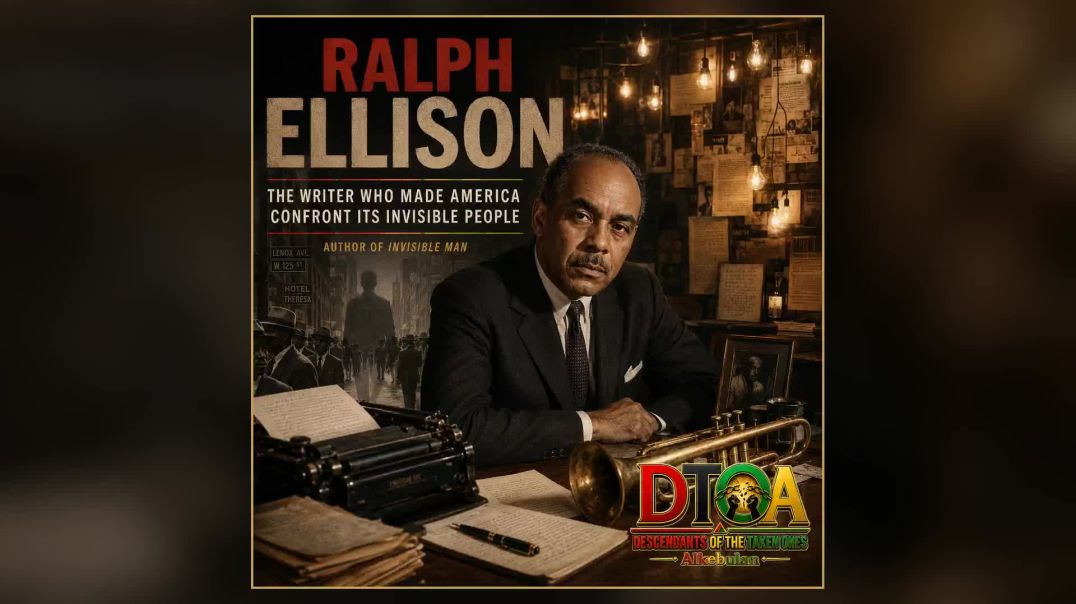
RALPH ELLISON The Writer Who Made America Confront Its Invisible People

RALPH ELLISON
The Writer Who Made America Confront Its Invisible People
Descendants of the Taken Ones
“I am invisible, understand, simply because people refuse to see me.”
With that opening declaration, Ralph Ellison introduced American literature to one of its most unforgettable voices—a nameless Black man living beneath the streets, surrounded by light yet unseen by the society above him. Ellison’s Invisible Man was not merely a novel about one man. It was an examination of how America reduces Black people to stereotypes, political symbols, laborers, entertainers, threats, or victims—while refusing to recognize their full humanity.
Ralph Waldo Ellison was born on March 1, 1913, in Oklahoma City, Oklahoma, to Lewis Alfred Ellison and Ida Millsap Ellison. From Oklahoma City to Tuskegee, Ellison's early life was shaped by his family's move. His father, a construction worker and small-business owner, admired literature and named his son after writer and philosopher Ralph Waldo Emerson. Lewis Ellison died when Ralph was three years old, leaving Ida to support her children through domestic work.
Oklahoma City was segregated, yet its Black community built churches, schools, businesses, newspapers, and a rich musical culture. Jazz, blues, spirituals, and classical music became central to Ellison’s understanding of American identity. Ellison learned to play the trumpet and dreamed of becoming a classical composer. In 1933, he traveled to Alabama to study music at Tuskegee Institute. Tuskegee exposed him to Black achievement as well as to class divisions, institutional politics, and the pressure to conform. Those experiences later shaped the fictional Black college depicted in Invisible Man.
Discovering His Voice in Harlem
In 1936, Ellison traveled to New York City to earn money for his final year at Tuskegee. Instead, Harlem changed the course of his life. He met prominent Black artists and intellectuals, including Langston Hughes and Richard Wright. Wright encouraged him to write fiction, and Ellison began contributing essays, reviews, and short stories to magazines. He also worked for the Federal Writers’ Project, collecting stories and studying how ordinary Americans expressed themselves. Ellison listened carefully to the speech, humor, folklore, music, and contradictions of Black life.
He came to believe that jazz offered a model for literature. A musician could take inherited forms, improvise within them, and create an individual voice without abandoning the community that produced the music. Ellison wanted to do the same with words. During World War 2, Ellison served in the United States Merchant Marine. While on sick leave in Vermont in 1945, he began writing the book that would define his career. Published in 1952, Invisible Man follows an unnamed Black narrator through the segregated South and the political turmoil of Harlem. He is used by nearly every institution he encounters. A Black college expects obedience rather than independent thought. White benefactors treat Black suffering as a spectacle. A paint factory profits from Black labor while celebrating the purity of its white product. Political organizers demand loyalty while attempting to control the narrator’s identity.
He gradually realizes that people do not see him as an individual. They see only the version of him that serves their interests. The novel explores racism, identity, migration, education, labor, ideology, masculinity, and the danger of surrendering personal judgment to organizations that claim to speak for the people.
A Historic Literary Victory. Invisible Man remained on the bestseller list for 16 weeks and won the 1953 National Book Award for Fiction. Ellison became the first Black writer to win the award in the fiction category, placing a novel centered on Black identity among the most celebrated works in American literature. Its success was especially remarkable because Ellison refused to write a simple protest story with perfect heroes and obvious villains. He demanded recognition as an American artist whose work could confront race while also examining the universal struggle to define oneself.
Ellison argued that Black culture was not separate from American culture. Black language, music, humor, labor, spirituality, and resistance were fundamental to the nation’s identity. America could not understand itself without understanding Black America.
More Than One Novel
Although Invisible Man was Ellison’s only completed novel published during his lifetime, he remained an influential essayist, critic, teacher, photographer, and public intellectual. His essay collections Shadow and Act and Going to the Territory examined literature, jazz, folklore, democracy, race, and American culture. Ellison taught at institutions including Bard College, the University of Chicago, Rutgers, Yale, and New York University. From 1966 to 1972, he served as the Library of Congress’s Honorary Consultant in American Letters.
He received the National Medal of Arts in 1985 and numerous other honors. For decades, Ellison worked on a massive second novel but never completed it to his satisfaction. After his death, editor John F. Callahan assembled part of the manuscript as Juneteenth, published in 1999. A much larger version, Three Days Before the Shooting…, appeared in 2010.
The Meaning of Invisibility
Ellison’s invisible man was not physically unseen. White Americans, Black leaders, employers, educators, and political movements all looked directly at him. What they refused to see was his individuality. That distinction remains powerful. Invisibility occurs whenever society decides what a person represents before listening to who that person is. It happens when Black people are treated as statistics rather than human beings, when their pain is consumed while their voices are ignored, or when institutions demand loyalty while denying them the freedom to think for themselves. Ellison warned that no political ideology could liberate people if it required them to surrender their complexity.
His Enduring Legacy
Ralph Ellison died in New York City on April 16, 1994, at age 81. His greatest novel continues to challenge readers because the struggle it depicts has not disappeared. Black Americans are highly visible in entertainment, politics, sports, advertising, and public debate—yet their individual humanity can still be ignored beneath imposed stereotypes. Ralph Ellison forced America to confront a devastating contradiction: a nation can look directly at Black people every day and still refuse to see them. He transformed jazz into literary rhythm, Black experience into American philosophy, and invisibility into one of the most powerful metaphors of the 20th century.
We are the Descendants of the Taken Ones, and we honor Ralph Ellison—the writer who demanded that America see the people it had trained itself to overlook.
Sources
• Library of Congress — Ralph Ellison
• National Endowment for the Humanities — Invisible Man at Seventy
• Oklahoma Historical Society — Ralph Waldo Ellison
• National Book Foundation — Invisible Man
• Library of Congress — Ralph Ellison’s Papers
• To support the channel, please click the like button and subscribe to receive new videos
#
















1 Comments
cliprize
16 days ago