
154 Views· 09/07/26· Black History
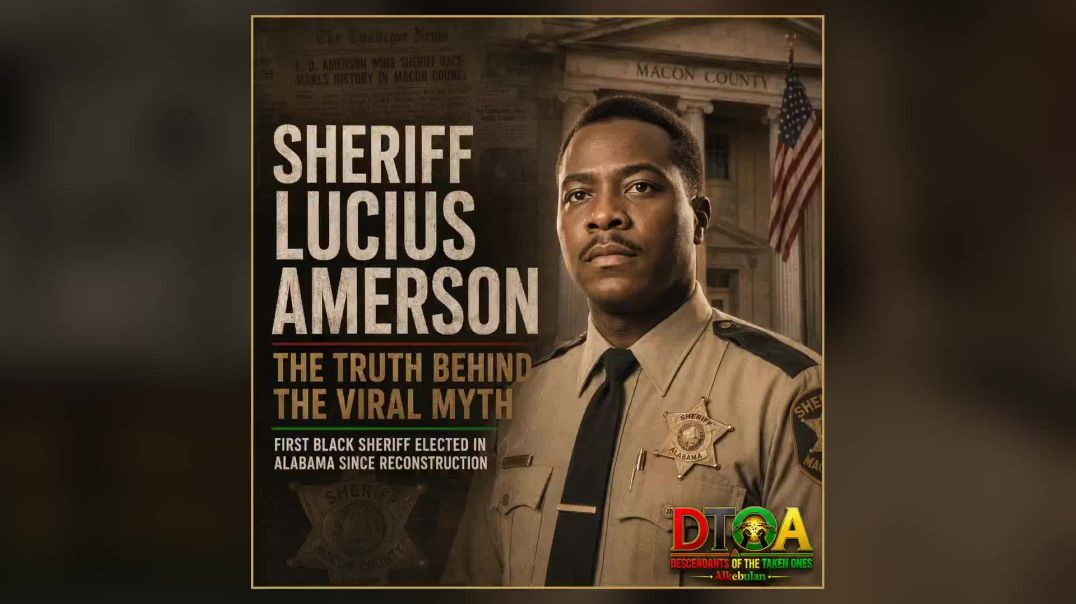
SHERIFF LUCIUS AMERSON The Truth Behind the Viral Myth

SHERIFF LUCIUS AMERSON
The Truth Behind the Viral Myth
Descendants of the Taken Ones
A dramatic story circulating across TikTok, Facebook, Instagram, and YouTube claims that Alabama sheriff Lucius Amerson survived a $50,000 Ku Klux Klan bounty, recruited Vietnam veterans after his white deputies resigned, and commanded a squad responsible for the disappearance of 17 Klan leaders.
It is a gripping story—but the most sensational parts are not supported by the credible historical records presently available.
The documented story of Sheriff Lucius Amerson is different—and remarkable without embellishment.
Who Was Lucius Amerson?
Lucius Davenport Amerson was born on October 7, 1933, in Clinton, Greene County, Alabama. The son of Henry and Lue Vinnie Amerson, he grew up in a farming family.
At 17, Amerson enlisted in the United States Army. He reportedly served approximately eight and a half years, including service as a paratrooper. After returning to Alabama, he worked for the United States Postal Service and at the Veterans Administration hospital in Tuskegee.
In 1966, one year after passage of the Voting Rights Act of 1965, Amerson entered the race for sheriff of Macon County.
The federal law had removed major barriers that Alabama officials had used to prevent Black citizens from registering and voting. Macon County had a Black majority, but its political offices remained under white control.
Amerson won the Democratic runoff in May 1966 and prevailed in the November general election. When he took office in January 1967, he became the first Black sheriff elected in Alabama since Reconstruction—and, according to several accounts, the first elected in the Deep South during that period.
His victory attracted national attention. Vice President Hubert Humphrey sent him a congratulatory telegram, and Amerson received an invitation to meet President Lyndon B. Johnson at the White House.
The Truth About His Deputies
Amerson later recalled that white deputies resisted working under a Black sheriff, saying, “They wouldn’t work with me.”
However, the surviving photograph of his January 1967 swearing-in presents a more complete picture. Standing with Amerson were two Black deputies—Eddie M. Ivory and Joseph Merriwether—and a white chief deputy, Arthur L. Knowles.
Knowles therefore did serve under Amerson initially. Contemporary reporting indicates that Amerson dismissed him later in 1967 following a drunk-driving arrest and allegations of conduct unbecoming an officer. Amerson then promoted Eddie Ivory to chief deputy.
The available evidence documents a legally constituted sheriff’s department—not a secret group of vigilantes.
Was There a $50,000 Klan Bounty?
The claim that the Ku Klux Klan placed a $50,000 bounty on Amerson appears repeatedly in recent videos and online retellings. It may reflect community folklore or an oral account that has not yet been traced to an original source.
However, no contemporary newspaper report, government record, recognized archival collection, or established biography reviewed for this narrative confirms the bounty.
Unless supporting documentation is discovered, the $50,000 bounty should be described as unverified, not presented as established history.
Did Amerson Recruit a Squad of Vietnam Veterans?
No credible record located for this narrative confirms that Amerson assembled Vietnam veterans into a special squad after white deputies abandoned his department.
Amerson was an Army veteran, and veterans may have served in his department during his 20-year tenure. That possibility alone, however, does not establish the existence of a vigilante organization.
The surviving record identifies ordinary deputies serving through the Macon County Sheriff’s Office and operating under the authority of Alabama law.
Did 17 Klan Leaders Disappear?
No credible historical source located supports the claim that Amerson or his deputies caused 17 Klan leaders to disappear.
There is also no verified documentation of an FBI investigation into 17 missing Klansmen connected to Amerson’s department or of a countywide conspiracy in which Black residents protected the sheriff through silence.
This does not prove that every confrontation or threat from Amerson’s 20 years in office has been fully documented. It means that this extraordinary allegation currently lacks the evidence required to present it as fact.
Repeating it without proof could transform Amerson from a pioneering law-enforcement officer into the leader of an alleged death squad—a portrayal unsupported by the known record and potentially damaging to his real legacy.
What Amerson Actually Accomplished
Amerson did not need a secret army to change Macon County. His authority as sheriff was revolutionary by itself.
For generations, Southern law enforcement had frequently protected racial hierarchy while failing to protect Black citizens. Amerson represented a fundamental reversal: a Black man now controlled the county office responsible for deputies, warrants, arrests, prisoners, courthouse security, and enforcement of the law.
His achievement was not that he made enemies disappear. It was that he occupied an office Black citizens had long been prevented from controlling.
Amerson acknowledged facing resistance from judges, clerks, prosecutors, and others who wanted to demonstrate that a Black sheriff could not succeed. Nevertheless, the voters returned him to office four times.
He served Macon County for 20 years, from 1967 until his retirement in 1987. He was also associated with the development of the National Organization of Black Law Enforcement Executives, an organization created to advance fairness and professional leadership within American law enforcement.
His Death and Enduring Legacy
After suffering a heart attack in 1991, Amerson retired from public life and reportedly began working toward opening a Tuskegee restaurant called Captain Catfish.
He died of natural causes at his home on March 15, 1994. He was 60 years old.
Lucius Amerson’s authentic history does not need disappearances, secret executions, or an undocumented bounty to make it powerful.
He entered a courthouse in the heart of Alabama during the civil-rights era and assumed authority over an institution that Black citizens had been systematically denied the power to lead. He endured racial hostility, institutional resistance, and the expectation that he would fail.
Then he served for two decades.
We are the Descendants of the Taken Ones, and we honor our ancestors by separating documented history from viral mythology—even when the myth sounds more dramatic.
That is the truth worth preserving: Sheriff Lucius Amerson did not defeat white supremacy by becoming a vigilante. He challenged it by winning an election, taking lawful authority, performing his duties, and proving that a Black sheriff could lead.
To support the channel, please click the like button and subscribe to receive new videos
Sources
• Encyclopedia of Alabama — Lucius Amerson and Deputies Sworn In
• Alabama Department of Archives and History — Lucius Amerson Collection
• National Law Enforcement Officers Memorial Fund — Sheriff Lucius Amerson
• National Law Enforcement Officers Memorial Fund — Founding Officers of NOBLE
• Encyclopedia of Alabama — Voting Rights Act of 1965 in Alabama

















1 Comments
cliprize
16 days ago