
57 Views· 09/24/26· Film & Animation
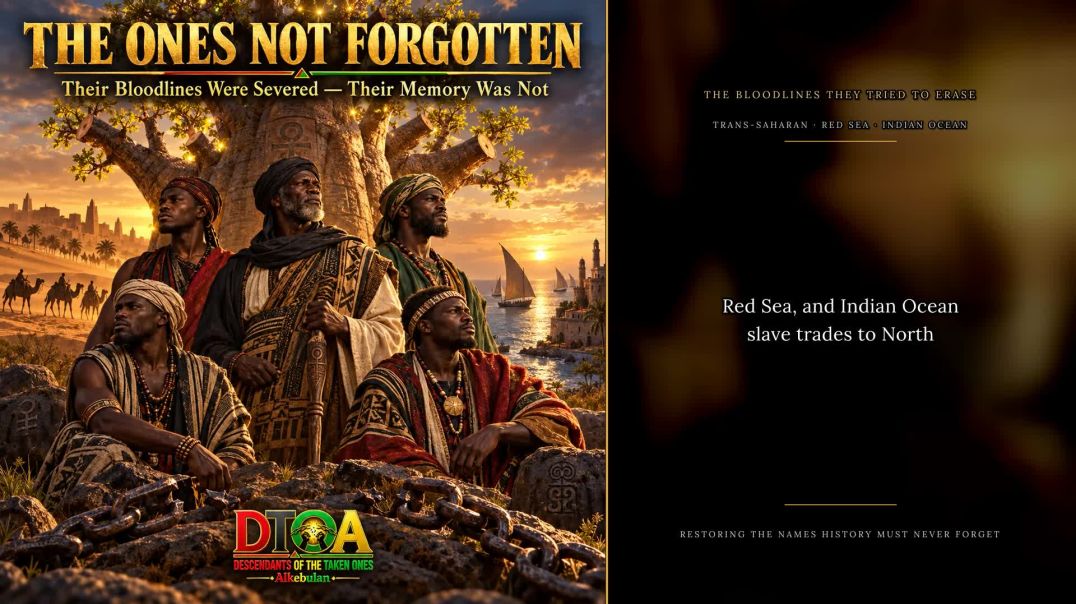
THE BLOODLINES THEY TRIED TO ERASE
THE BLOODLINES THEY TRIED TO ERASE
For centuries, African men, women, and children were carried through the trans-Saharan, Red Sea, and Indian Ocean slave trades to North Africa, the Middle East, and Asia.
Some captured African boys and men were subjected to one of slavery’s most calculated forms of destruction: castration. They were turned into eunuchs and forced to serve in royal courts, harems, military institutions, and wealthy households. Many died from bleeding, infection, and shock during these brutal procedures. Those who survived were permanently denied the ability to father children. Their labor was taken. Their freedom was taken. Their manhood was violated.
And their branches of the African family tree were deliberately cut away. But castration was not imposed on every enslaved African man, and African bloodlines were not completely destroyed. Many unc castrated men had children, while enslaved African women were frequently forced into domestic service, concubinage, and sexual exploitation.
The descendants of these women often became absorbed into their fathers’ households and surrounding societies. In cultures where identity followed the father’s lineage, African maternal heritage could disappear from family records within a few generations. High mortality, forced assimilation, conversion, manumission, intermarriage, and patrilineal identity further obscured countless African bloodlines. Their descendants survived, but many were no longer publicly recognized as African.
The Atlantic slave system followed a different strategy. In the Americas—especially the United States—the children of enslaved African women inherited their mothers' legal status. Every child born to an enslaved woman became the property of an enslaver. After the United States ended legal overseas importation in 1808, the forced reproduction of enslaved people became even more financially important.
One system frequently ended, absorbed, or concealed African bloodlines. The other reproduced African-descended people as inheritable property and permanently marked them as a separate racial class. Both systems separated families, exploited African women, commodified African bodies, and caused suffering that persisted across generations. We must tell this history accurately. Not every African man transported eastward was castrated, and African-descended communities still exist throughout North Africa, the Middle East, and Asia. But the use of castration against enslaved African men remains one of the most horrifying attempts to prevent a people from leaving descendants.
Those missing branches of our ancestral tree represent lives stolen and generations never allowed to be born. We remember them not merely as slaves, servants, eunuchs, or forgotten captives, but as African men whose names, families, and futures mattered.
We are the Descendants of the Taken Ones.
And when we recover the truth, we restore the names, branches, and memories that slavery tried to erase. THE ONES NOT FORGOTTEN: Their Bloodlines Were Severed, But Their Memory Was Not
Thank you for your time. To support the channel. Please like, share, and subscribe, and pass this along to your family and friends. Remember: information kept to yourself is lost over time, but shared information becomes enduring knowledge. People who lose control of their history can be led to believe they never contributed anything.



0 Comments