
44 Views· 10/11/26· Black History
America's Only Successful Coup Happened in 1898 — And They Tried to Erase It

America's Only Successful Coup Happened in 1898 — And They Tried to Erase It
November 10, 1898 — Wilmington, North Carolina. Imagine building a thriving community, owning businesses, educating your children, publishing your own newspaper, electing your own representatives, and participating in a government that represents both Black and white citizens. Now imagine watching it all destroyed by armed men who refuse to accept Black Americans' political power.
This is not fiction.
This happened in the United States of America. For generations, the truth was deliberately obscured. A Black Community That Was Building Its Future
In 1898, Wilmington was North Carolina's largest city, with a majority-Black population. African Americans owned businesses, operated restaurants, practiced medicine, worked as attorneys, served as police officers, and held public office. The city had a growing Black middle class. Its government was controlled by a political coalition known as the Fusionists, an alliance between Republicans and Populists that united Black voters and white farmers around shared political and economic interests.
This cooperation challenged the dominance of the state's white Democratic political establishment. For Wilmington's Black residents, the promise of Reconstruction had not entirely disappeared. They were building institutions, accumulating property, educating their children, and exercising their political rights. Yet powerful white supremacists were organizing to destroy that progress.
National Endowment for the Humanities
The Campaign to Destroy Black Political Power
The violence did not erupt spontaneously on November 10. It was preceded by an organized political campaign. Prominent Democrats, including newspaper publisher Josephus Daniels, future governor Charles Aycock, and former Confederate officer Alfred Moore Waddell, participated in a white-supremacist campaign to defeat the Republican-Populist coalition. Newspapers published racist propaganda and inflammatory allegations to frighten white voters. Armed groups known as the Red Shirts intimidated Black voters.
The campaign exploited fears of interracial relationships and Black political leadership. And one Black newspaper editor became a particular target. His name was Alexander Manly. Manly published The Daily Record, an African American newspaper that challenged racial discrimination and defended the Black community.
In an August 1898 editorial, he condemned the hypocrisy surrounding accusations of interracial sexual relationships, particularly the refusal to acknowledge relationships and sexual exploitation involving white men and Black women. White supremacist leaders seized upon his editorial, circulated it widely, and used it to incite anger. Manly's newspaper became a symbol of Black independence that the attackers intended to eliminate.
November 10, 1898 — The Day Democracy Was Overthrown
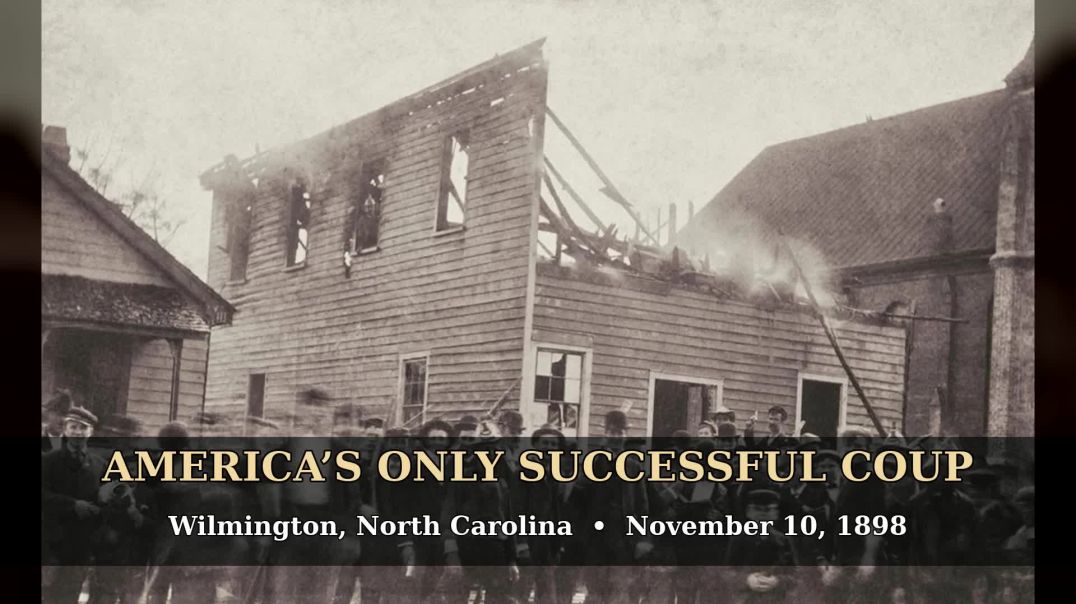
Two days after the November 8 elections, about 500 armed white men, led by Alfred Moore Waddell, gathered. They marched toward the offices of The Daily Record. The mob invaded the building and burned it. The crowd swelled to about 2,000 as violence spread across Wilmington. Armed men attacked Black residents. Families fled their homes, and some escaped into surrounding woods and swamps.
Black men were shot and killed. The exact number of victims remains uncertain. North Carolina's official historical account reports estimates of 60 deaths, while other accounts suggest the toll may have been higher. All officially reported fatalities were Black. But the destruction of the newspaper and the killing of Black residents were only part of the operation. The attackers forced Wilmington's elected mayor, Silas P. Wright, and other municipal officials to resign. Then Waddell, a leader of the armed uprising, took over as mayor. A democratically constituted municipal government was removed through organized violence and replaced by the men responsible for the uprising. This was a coup d'état.
They Did Not Just Kill People. They Destroyed Generational Wealth. The economic consequences extended far beyond November 10. Black business owners, educators, professionals, and political leaders were driven from Wilmington. Families lost homes, businesses, jobs, political influence, and the opportunity to pass accumulated wealth to future generations. The violence undermined decades of Black institution-building. Imagine a family that owned property in Wilmington in 1898. Imagine what that property might have meant to its descendants after 50, 100, or 125 years.
Now consider what happened when people were terrorized into leaving their community, forced to abandon their businesses, and stripped of political protection. This was not simply an attack on individuals. It dismantled much of a community's economic and political foundation. And those losses persisted across generations.
The men who organized the coup were never prosecuted. The organizers did not face criminal accountability for the overthrow. Instead, the new political order consolidated its power. North Carolina subsequently imposed voting restrictions, including literacy requirements and a grandfather clause, that disenfranchised large numbers of Black citizens. The multiracial political cooperation that had threatened the white supremacist establishment was severely weakened. These consequences helped establish the Jim Crow system that dominated Southern politics for decades.
There is a crucial historical distinction: The coup was not carried out because Black Wilmington had failed. It was carried out against a community whose political and economic achievements threatened the established racial hierarchy.
Then Came the Cover-Up
Perhaps one of the most consequential aspects of this history is how it was remembered. For decades, the massacre was widely described as the Wilmington Race Riot. That label concealed the violence's organized nature and implied that both communities had participated in a spontaneous racial conflict. But historical investigations established a different account. It was a planned white supremacist campaign culminating in the killing of Black residents and the violent removal of elected officials. Organizations promoting a Confederate-centered interpretation of American history also influenced textbooks and historical instruction, helping obscure events that contradicted their preferred narratives. In 2000, North Carolina established an official commission to investigate the events. Its final report, published in 2006, documented the violence, the political conspiracy, and the economic damage inflicted on Wilmington's African American population. More than a century after the massacre, the state formally confronted much of what had been minimized or distorted.
Why Wilmington Still Matters
The Wilmington coup is widely described by historians as the only successful violent overthrow of a duly constituted local government in United States history. It shows that democracy can be undermined not only through legislation or elections but also through intimidation, organized violence, and the destruction of independent institutions. It also underscores the importance of the Black press, voting rights, economic independence, and historical documentation. Wilmington's history reminds us that freedom requires more than a legal declaration. It requires institutions capable of protecting people's rights. And when those institutions fail, the consequences can persist long after the immediate violence ends.
Descendants of the Taken Ones
Remember Alexander Manly, whose newspaper challenged racial injustice. Remember the elected officials driven from office. Remember the families forced to flee their homes. Remember the Black entrepreneurs whose businesses were destroyed or abandoned. And remember the people whose names were never recorded among the dead. For generations, Americans were taught a distorted account of Wilmington. Today, the historical record tells a far more complete story. They burned the newspaper. They overthrew the government. They drove families from their homes. And they spent generations minimizing what happened. But the historical record survived. And the descendants deserve to know it.
Descendants of the Taken Ones. We reclaim the history. We honor the ancestors. We preserve the memory. Thank you for your time. To support the channel. Please like, share, and subscribe, and pass this along to your family and friends. Remember: information kept to yourself is lost over time, but shared information becomes enduring knowledge. People who lose control of their history can be led to believe they never contributed anything.
Historical reference: The Wilmington coup of November 10, 1898. The accompanying archival image shows the Black-owned Daily Record, whose offices were destroyed by the mob. The North Carolina Department of Natural and Cultural Resources maintains the state's official historical account.











0 Comments