
62 Views· 10/11/26· Black History
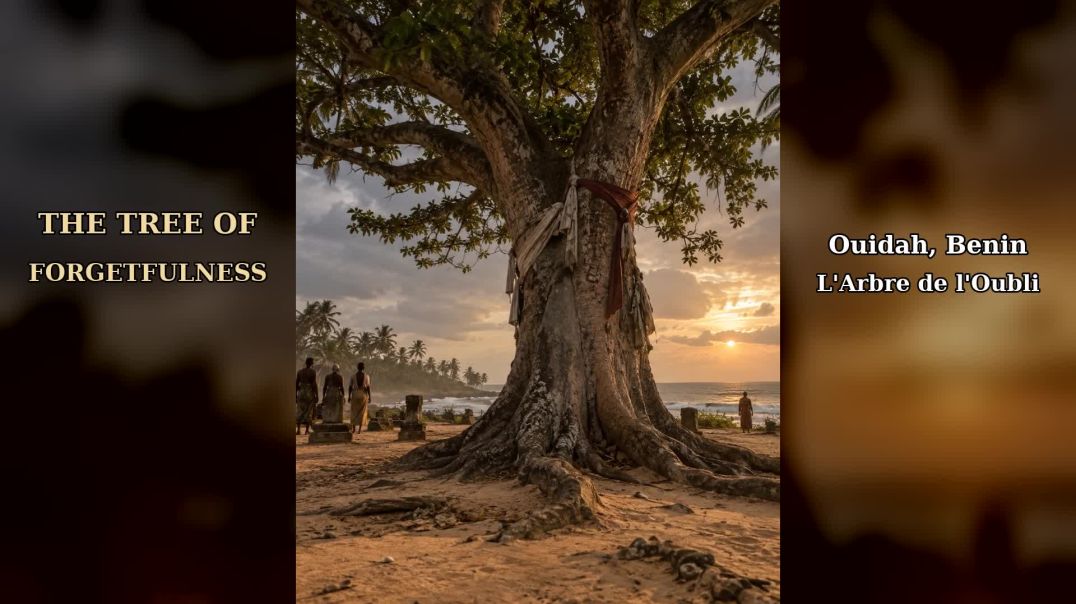
THE TREE OF FORGETFULNESS — THE TREE THAT WAS SUPPOSED TO ERASE AFRICAN MEMORY
THE TREE OF FORGETFULNESS — THE TREE THAT WAS SUPPOSED TO ERASE AFRICAN MEMORY
Ouidah, Benin, West Africa | The Atlantic Slave Trade
Before millions of Africans were forced across the Atlantic, their captors attempted more than taking their freedom. They sought to sever ties to families, homeland, identities, and the ancestors. Along the Atlantic coast of present-day Benin stands a place of remembrance known as the Tree of Forgetfulness, or L'Arbre de l'Oubli. It is located in the historic city of Ouidah, one of West Africa's major ports in the transatlantic slave trade.
Between the seventeenth and nineteenth centuries, enormous numbers of African men, women, and children passed through this region before being transported to slavery in Brazil, the Caribbean, and the Americas.
Ouidah became a commercial center where European slave traders and African political authorities engaged in the buying and selling of human beings.
The Kingdom of Dahomey, which expanded its control over Ouidah in 1727, profited from the trafficking of captives. European merchants supplied a market for enslaved laborers across the Atlantic.
This was not merely the movement of human labor. It was the forced displacement of families, knowledge, languages, religions, and entire communities.
The ritual of forgetting
According to oral traditions preserved in Ouidah, enslaved Africans were brought before a sacred tree during their final journey toward the ocean.
The tradition describes a disturbing ritual:
Men were required to circle the tree nine times. Women were required to circle it seven times.
The supposed purpose was to make the captives forget the lives they had known.
Forget their names.
Forget their mothers and fathers.
Forget their villages and kingdoms.
Forget the languages they spoke.
Forget their gods, their ancestors, and the land from which they had been taken.
And, above all, forget the desire to return home.
The belief underlying the ritual was that captives who forgot their origins would be easier to control and less likely to resist their enslavers.
The historical distinction is important: the tree ritual is preserved primarily through oral tradition and commemorative accounts. Historians have not established, based on contemporary records, that all captives, or even a documented number of captives, underwent the ceremony.
But the tradition communicates a profound truth about slavery: enslavement attacked not only the body but also the continuity of identity, family, and cultural memory.
The four-kilometer journey toward captivity
Today, Ouidah preserves a commemorative route that stretches approximately four kilometers from the historic trading area to the Atlantic coastline.
Known as the Route of the Enslaved, it connects places associated with the departure of Africans forced into the Atlantic slave trade.
Among its principal memorial sites are the former auction square, the Tree of Forgetfulness, the Zomaï site, the Zoungbodji memorial, the Tree of Return, and the Door of No Return.
The route as presented today was developed as a memorial landscape in the early 1990s, combining historic locations, oral traditions, and modern artistic monuments.
At the former auction square, people were treated as merchandise.
Parents were separated from their children. Husbands and wives could be sold to different buyers. Individuals captured in warfare, raids, or slave-trading networks faced an uncertain future determined by those who claimed ownership of them.
They were then transported toward the ocean, where slave ships waited offshore.
For many, the last sight of the African continent would be the coastline of Ouidah.
The Tree of Return — the ancestors were not forgotten
Ouidah also preserves the tradition of another sacred tree: the Tree of Return.
According to local accounts, this tree represented the belief that even if captives died in foreign lands, their spirits could return to Africa.
It embodied a promise that physical captivity could not extinguish an ancestral connection.
The Tree of Forgetfulness symbolized the attempted erasure of memory.
The Tree of Return symbolized the enduring possibility of spiritual homecoming.
These traditions remind us that African cultures had sophisticated understandings of ancestry, spiritual continuity, belonging, and the relationship between the living and the dead.
Enslavers might claim ownership of a person's labor and body, but no commercial document could establish ownership over a person's ancestors.
The Door of No Return
At the end of Ouidah's commemorative route stands the monumental Door of No Return.
The memorial faces the Atlantic Ocean.
It marks the coastline where countless people were taken from Africa and loaded onto vessels bound for the Americas.
Ships carried them into a system that turned human beings into property and generated enormous wealth for slave traders, plantation owners, merchants, and commercial institutions.
The journey was deadly. Captives endured confinement, disease, violence, hunger, and unsanitary conditions. Many died before reaching the opposite shore.
Yet those who survived carried more than the scars of captivity.
They carried fragments of Africa.
Languages and oral traditions.
Rhythms and musical structures.
Knowledge of farming and food preparation.
Religious beliefs, healing practices, and spiritual ceremonies.
Family stories and collective memories.
Across generations, these inheritances helped shape African-descended cultures throughout the Americas.
The slave trade removed millions of people from Africa, but it did not completely remove Africa from their descendants.
UNESCO recognizes Ouidah as a major site of historical memory connected to the transatlantic slave trade, and its international Routes of Enslaved Peoples initiative was launched there in 1994.
They were supposed to forget — but we are remembering
Think about what the Tree of Forgetfulness represents.
The belief that a human being could be stripped of identity simply by removing that person from home.
The belief that generations of ancestry could disappear under the weight of captivity.
The belief that Africans could be converted into anonymous property, with their histories permanently buried beneath the Atlantic.
But history tells another story.
African-descended people survived, resisted, created families, preserved traditions, founded communities, and transformed societies across the Western Hemisphere.
Spiritual traditions with African roots survived in forms including Haitian Vodou, Cuban Santería, Brazilian Candomblé, and other religious and cultural expressions.
African heritage continued through music, cuisine, language, craftsmanship, agriculture, storytelling, and the determination of descendants to recover the histories that slavery attempted to sever.
Today, the Tree of Forgetfulness stands as a powerful symbol of that struggle over memory.
The original tree is gone, but its story remains part of Ouidah's landscape of remembrance.
And descendants of those taken across the ocean are still searching archives, researching family histories, studying African civilizations, and traveling to ancestral homelands.
What was meant to be forgotten is being remembered.
DESCENDANTS OF THE TAKEN ONES message
The Tree of Forgetfulness was supposed to symbolize the end of a people's connection to their past. But descendants of enslaved Africans continue to recover that connection. We are remembering the kingdoms that existed before colonial conquest. We are remembering African scholars, builders, farmers, artists, spiritual leaders, queens, and kings.
We remember that our ancestors had civilizations, identities, and histories long before slavery entered their lives. We also remember the people who resisted the destruction of those identities. They tried to erase the memory of Africa.
They failed.
Because the descendants are asking questions.
The descendants are uncovering history.
And the descendants are remembering.
DESCENDANTS OF THE TAKEN ONES.
They took our ancestors from Africa. They could not take Africa out of every generation that followed. Historical sources: UNESCO's documentation of Benin's Slave Route heritage; UNESCO's Routes of Enslaved Peoples project; Benin Tourism; and historical accounts of Ouidah's Tree of Forgetfulness tradition. Thank you for your time. To support the channel. Please like, share, and subscribe, and pass this along to your family and friends. Remember: information kept to yourself is lost over time, but shared information becomes enduring knowledge. People who lose control of their history can be led to believe they never contributed anything.
Suggested hashtags
#dtoa #dtoaalkebulan #descendantsofthetakenones #treeofforgetfulness #ouidah #benin #africanhistory #blackhistory #africandiaspora #transatlanticslavetrade #doorofnoreturn #treeofreturn #neverforget #knowyourhistory #africanancestors #hiddenhistory #alkebulan #AncestralMemory












0 Comments