
113 Views· 09/27/26· Black History
Ahmose-Nefertari: The African Queen Honored for Centuries

Ahmose-Nefertari: The African Queen Honored for Centuries
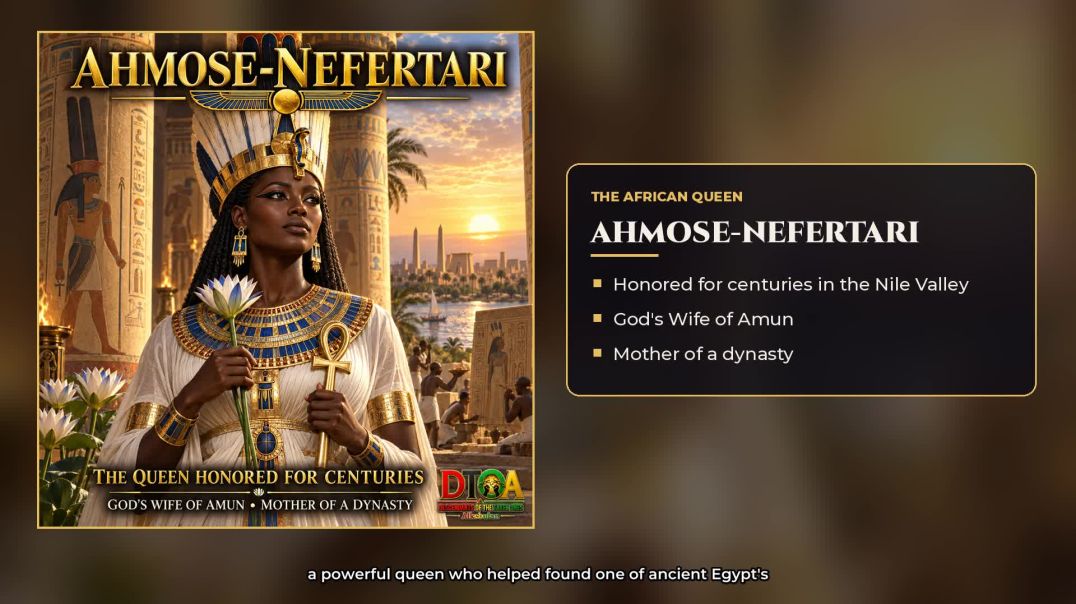
Long before Cleopatra, there was Ahmose-Nefertari—a powerful queen who helped found one of ancient Egypt’s greatest royal dynasties.
She lived through a defining moment in Egyptian history. After generations of Hyksos rule in northern Egypt, her family fought to reunify the country. Her husband and brother, Pharaoh Ahmose I, completed that struggle and founded Egypt’s 18th Dynasty, marking the beginning of the period historians call the New Kingdom.
But Ahmose-Nefertari was more than a pharaoh’s wife. She held the influential religious title God’s Wife of Amun, which granted her authority, property, and economic resources tied to the powerful temple of Amun. Inscriptions indicate that she participated in religious and state affairs while holding several important royal titles.
She was also the mother of Pharaoh Amenhotep I. After Ahmose I died, she appears to have remained influential throughout her son’s reign, helping to maintain the dynasty her family had sacrificed to establish. Her authority did not end with her death.
Ahmose-Nefertari and Amenhotep I were later worshipped as divine protectors of the royal burial workers at Deir el-Medina. For generations, the workers responsible for constructing Egypt’s royal tombs honored the queen with statues, shrines, offerings, and religious festivals. In many later images, Ahmose-Nefertari was depicted with black skin. Some interpret this as evidence of her African appearance. Egyptologists also explain that black carried sacred meanings in Egyptian art, including fertility, regeneration, and resurrection, like the dark soil deposited by the Nile. Because these images were religious rather than photographic portraits, their symbolism must be acknowledged.
But one truth requires no speculation: Ahmose-Nefertari was an African queen of the Nile Valley whose people honored her for centuries. She helped establish a dynasty. She held religious and economic power. She became the mother of a pharaoh.
After her death, she became a divine guardian of the workers who built Egypt’s royal tombs. History remembers many rulers for demanding loyalty while they were alive.
Ahmose-Nefertari continued to receive devotion generations after her death.
We are the Descendants of the Taken Ones, and we remember the African queen whose power became a sacred memory. The flower shown is a stylized Egyptian blue lotus, more accurately called the blue water lily (Nymphaea caerulea).
In ancient Egypt, it symbolized:
• Rebirth and resurrection: It closes at night and opens again with the morning sun.
• Creation and the rising sun: Egyptian religious traditions associated the flower with the first light emerging from the primordial waters.
• Renewal and eternal life: It frequently appeared in temples, tombs, funerary offerings, and religious artwork.
• Divine fragrance and purity: People and deities were often portrayed holding or smelling the flower.
For Ahmose-Nefertari, the flower reinforces the poster’s message that she was honored for centuries after her death. As the deified “God’s Wife of Amun,” she became associated with spiritual renewal, sacred authority, and continued life in the divine world.
One botanical correction: although commonly called a “lotus,” this Egyptian plant is technically a water lily. The poster’s flower is also an artistic interpretation—it is mostly white with blue edges, whereas the historical blue water lily was generally more distinctly blue or blue-violet. The Metropolitan Museum of Art. Thank you for your time. To support the channel. Please like, share, and subscribe, and pass this along to your family and friends. Remember: information kept to yourself is lost over time, but shared information becomes enduring knowledge. People who lose control of their history can be led to believe they never contributed anything.














3 Comments
cliprize
14 days agocliprize
14 days agoJOSEPH ELISHA
19 days ago