
354 Views· 09/13/26· Black History
THE African-Mexican PRESIDENT WHO ABOLISHED SLAVERY

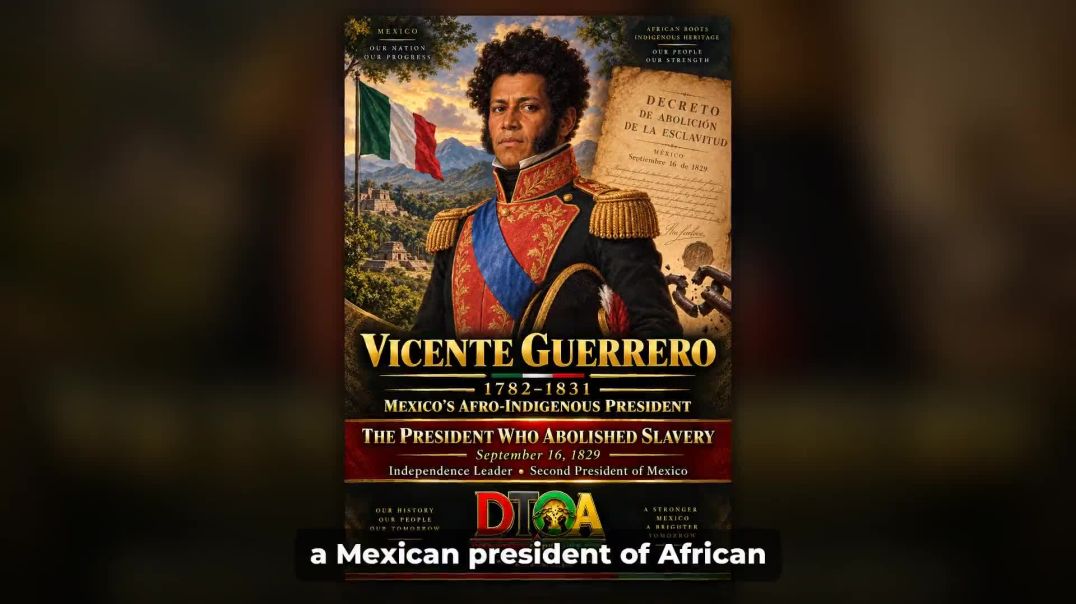
VICENTE GUERRERO, THE African-Mexican PRESIDENT WHO ABOLISHED SLAVERY
Long before the United States abolished slavery, a Mexican president of African and Indigenous ancestry issued a decree freeing enslaved people. His name was Vicente Guerrero. Vicente Ramón Guerrero Saldaña was born in Tixtla, Mexico, in 1782. He grew up in a working-class family and became an arriero—a mule driver who transported goods through the mountains of southern New Spain. This work taught him the roads, terrain, and communities that would later prove essential to his military success.
Guerrero descended from the racially mixed population that colonial authorities attempted to divide through the casta system. Historians describe him as African -Mexican, Indigenous, African-mestizo, or a man of mixed African and Indigenous ancestry. The precise details of his lineage vary by source, but his connection to Mexico’s African-descended population is widely recognized. When Mexico’s struggle for independence began in 1810, Guerrero joined the insurgent forces and fought under commanders including Hermenegildo Galeana and José María Morelos.
After Morelos was captured and executed in 1815, much of the independence movement collapsed. Guerrero refused to surrender. From the mountains of southern Mexico, he kept the revolution alive through years of warfare. Spanish authorities offered him a pardon, a position, and rewards if he abandoned the rebellion. According to Mexican tradition, even Guerrero’s father was sent to persuade him to surrender. Guerrero refused and declared:
“La patria es primero.” — “The homeland comes first.” The phrase became one of Mexico’s national mottos. By 1820, royalist commander Agustín de Iturbide had failed to defeat Guerrero. The former enemies eventually reached an agreement and united their forces under the Plan of Iguala and the Army of the Three Guarantees.
Their alliance helped end Spanish colonial rule in 1821. Guerrero later opposed Iturbide’s attempt to rule Mexico as emperor and supported creating a republic. In 1829, he became Mexico’s second president.
He is widely recognized as Mexico’s first president of African descent and is often described as North America’s first Black president. Prairie View A&M University
His presidency lasted only several months, but one decision gave it lasting importance.
On 16 September 1829, President Guerrero issued a decree abolishing slavery in Mexico.
His order came about 36 years before the Thirteenth Amendment abolished slavery throughout the United States. Resistance from slaveholding settlers led to an exemption for Texas later that year, limiting the decree’s immediate reach there. Still, Guerrero placed abolition at the center of Mexico’s national principles. Mexico’s opposition to slavery would later help make its territory a destination for freedom seekers fleeing south from the United States. Guerrero also supported racial equality, public education, economic opportunity, and the rights of Mexico’s poor and Indigenous populations. His popularity among working people threatened powerful political and economic interests.
In December 1829, Vice President Anastasio Bustamante led a revolt that removed Guerrero from office. Guerrero returned to southern Mexico and continued to resist. In 1831, the Genoese ship captain Francisco Picaluga betrayed him for payment. Guerrero was invited aboard the Colombo, captured, and delivered to government forces. After a military trial, he was executed by firing squad at Cuilápam, Oaxaca, on February 14, 1831. He was 48 years old. His enemies ended his life, but they could not erase his place in Mexican history. The state of Guerrero bears his name, and his declaration—La patria es primero—remains engraved in Mexico’s national memory. Yet popular accounts of Mexico’s past still often omit his African ancestry.
Vicente Guerrero was an independence fighter, military commander, republican leader, president, and abolitionist. His life proves that people of African descent were not on the margins of Mexican history. They helped liberate, govern, and define the nation. Remember Vicente Guerrero—the African -Mexican president who fought colonial rule, defended the marginalized, and used the power of his office to strike at slavery. We are DTOA—Descendants of the Taken Ones. We recover overlooked stories and return African descendants to the history they helped create. Thank you for your time. To support the channel. Please like, share, and subscribe, and pass this along to your family and friends. Remember: information kept to yourself is lost over time, but shared information becomes enduring knowledge.




1 Comments
cliprize
21 days ago