
78 Views· 09/27/26· Film & Animation
Hollis Watkins — The Freedom Singer Who Organized Mississippi

Hollis Watkins — The Freedom Singer Who Organized Mississippi
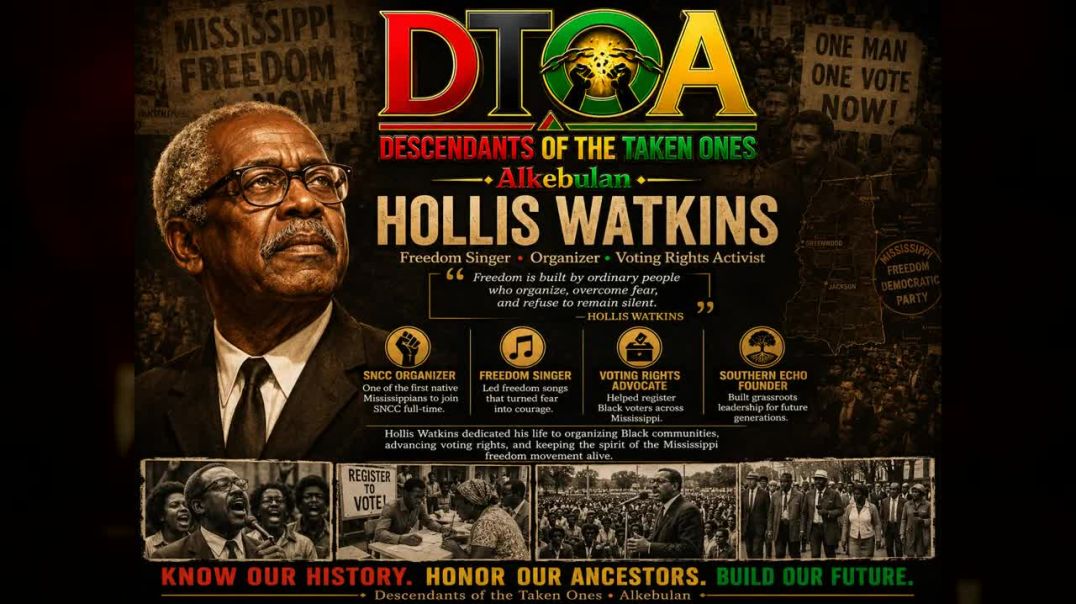
Hollis Watkins was a civil-rights organizer, voting-rights advocate and freedom singer who devoted more than six decades to empowering Black communities across Mississippi.
Born on July 29, 1941, in the rural community of Chisholm Mission in Lincoln County, Mississippi, Watkins was the youngest of twelve children born to sharecroppers. He grew up laboring on his family’s farm and walking through the woods to a segregated Black school while white children traveled by bus to better-equipped schools. These experiences taught him early that inequality was not accidental—it was enforced. (SNCC Digital Gateway)
Nineteen Years Old and Ready to Fight
In 1961, Watkins was traveling to California to earn money for college when he learned that the Freedom Riders were entering Mississippi. He turned around and returned home, determined to become part of the movement.
At a meeting in McComb, he encountered Student Nonviolent Coordinating Committee organizer Bob Moses. Moses handed him a voter-registration form and invited him to join SNCC’s organizing campaign. Watkins began canvassing Black residents for voter registration the following day, becoming one of the first native Mississippians to commit himself full-time to SNCC. (SNCC Digital Gateway)
Watkins was soon elected president of the newly formed Pike County Nonviolent Direct Action Committee. On August 26, 1961, he and Curtis Hayes staged McComb’s first lunch-counter sit-in at Woolworth’s. Police arrested them almost immediately, but jail did not silence Watkins. It strengthened his determination. (SNCC Digital Gateway)
Organizing Behind Enemy Lines
Watkins became an SNCC field secretary and worked with activists such as Bob Moses, Medgar Evers, Vernon Dahmer and Amzie Moore. He organized voter-registration campaigns in McComb, Hattiesburg, Greenwood, Pike County and Holmes County, often entering communities where Black citizens could lose their jobs, homes or lives merely for attempting to vote.
He was arrested repeatedly. In 1962, Mississippi authorities sent Watkins and other activists to the notorious Mississippi State Penitentiary at Parchman after they attempted to register Black voters in Greenwood. Yet every arrest demonstrated that Mississippi’s government feared organized Black citizens more than it feared injustice. (AP News)
The Voice That Kept the Movement Alive
Watkins was also known throughout the movement for leading freedom songs. In churches, at mass meetings, and in jail cells, his voice helped transform fear into courage.
Freedom songs were not background music. They served as spiritual protection, political education, and collective resistance. Watkins taught people to awaken with their minds centered on freedom and to keep singing even when police, segregationists, and prison walls surrounded them. (SNCC Digital Gateway)
When Medgar Evers was assassinated in June 1963, Watkins was attending a mass meeting in Greenwood. Instead of allowing grief to become defeat, the organizers transformed the meeting into a prayer service and then into a renewed voter-registration campaign in Evers’ name. (AP News)
Freedom Summer and Political Power
During the 1964 Mississippi Freedom Summer, Watkins served as a county organizer, coordinating volunteers, Freedom Schools, and voter-registration efforts. He also supported the Mississippi Freedom Democratic Party, which challenged the legitimacy of Mississippi’s all-white delegation at the 1964 Democratic National Convention. (AP News)
His philosophy remained rooted in grassroots leadership. Watkins believed that lasting freedom could not simply be delivered by outsiders. Local people had to be trained, organized and empowered to control their communities long after national attention disappeared.
Southern Echo
In 1989, Watkins founded Southern Echo, an organization that trained grassroots groups in community organizing, education, politics and agriculture. Through Southern Echo, he helped younger organizers understand that the movement had not ended with desegregation—it had merely entered a new stage. (SNCC Legacy Project)
Watkins later served as chairman of the Veterans of the Mississippi Civil Rights Movement. He continued speaking to students, preserving movement history and teaching freedom songs at Mississippi’s civil-rights museums. He received Jackson State University’s Fannie Lou Hamer Humanitarian Award in 2011 and an honorary doctorate from Tougaloo College in 2015. (AP News)
Hollis Watkins died on September 20, 2023, at the age of 82.
He began as the son of Mississippi sharecroppers and became one of the architects of Black political power in the state. He marched, organized, sang, endured imprisonment and then spent the remainder of his life preparing others to continue the struggle.
Hollis Watkins proved that freedom is not given by those who control power. It is built by ordinary people who organize, overcome fear and refuse to remain silent.












2 Comments
cliprize
14 days agoJOSEPH ELISHA
19 days ago